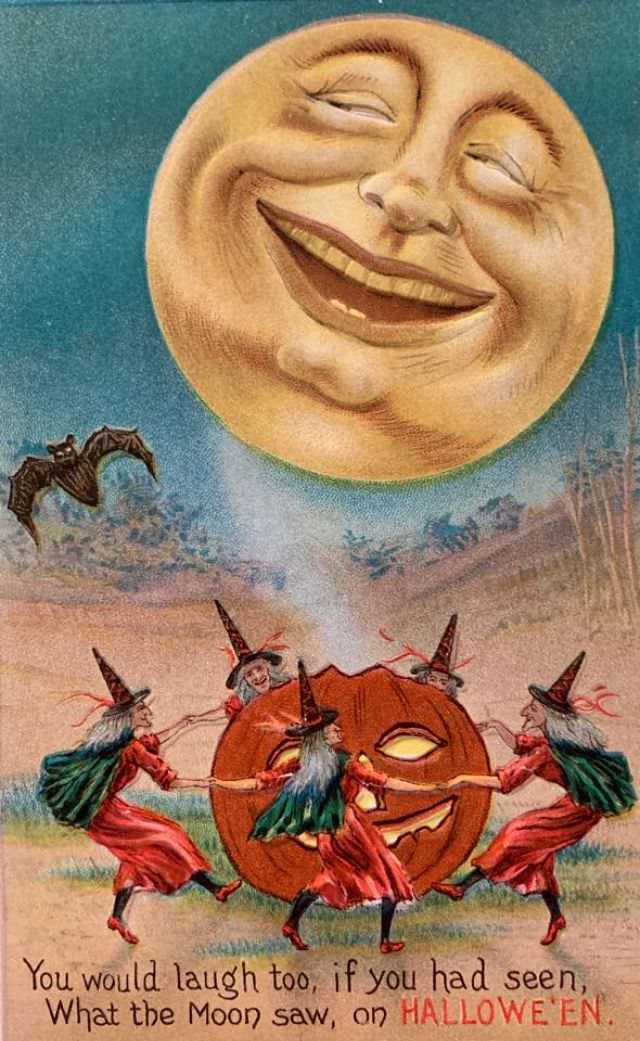
High overhead, a broad, sleepy-eyed Moon grins as if it’s in on a private joke, its face rendered in the playful, storybook style that made early cover art so instantly memorable. Below, the Halloween world becomes a stage: four witches in pointed hats whirl hand-in-hand around a carved jack‑o’‑lantern, their skirts and capes flaring with the motion. A bat cuts across the sky at the edge of the scene, adding just enough mischief to make the laughter feel earned.
The caption at the bottom—ending with a bold “HALLOWE’EN”—anchors the illustration in an era when the holiday was often spelled that way and marketed with a wink rather than a scare. Instead of dread, the mood is light and theatrical, built from exaggerated expressions, warm autumn colors, and the familiar folklore of witches, bats, and pumpkin lanterns. It’s the kind of seasonal imagery designed to amuse onlookers, as if inviting readers to share the Moon’s knowing smile.
As a piece of historical Halloween cover art, “What the Moon Saw” offers a window into how popular culture once packaged the supernatural as cheerful entertainment. The composition pulls your eye from the laughing Moon to the spinning circle of dancers, a visual loop that feels like a nursery rhyme brought to life. For collectors, historians, and anyone searching for vintage Halloween art, antique holiday illustration, or classic jack‑o’‑lantern imagery, this print preserves the playful side of October nights—when even the Moon could be persuaded to laugh.