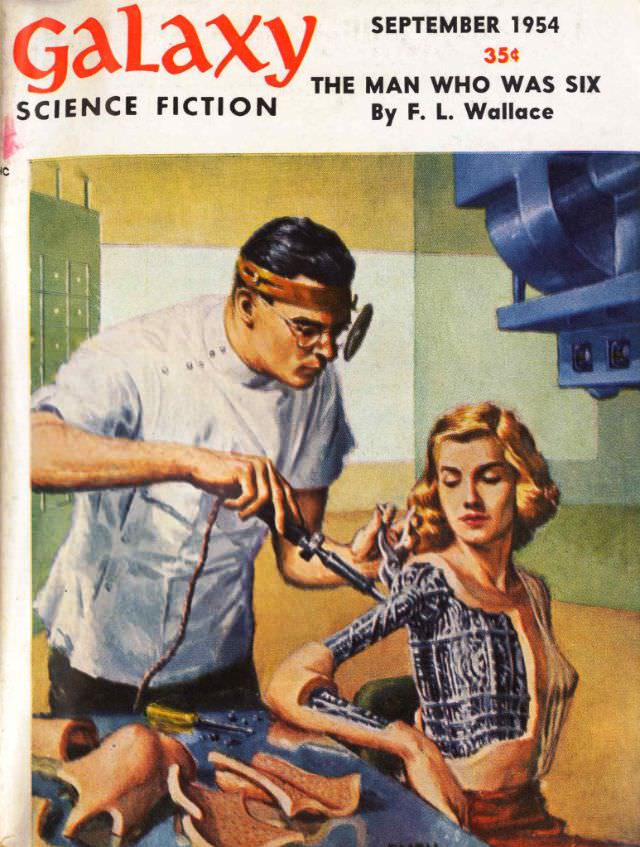
Bold red lettering announces *Galaxy Science Fiction* while the upper corner pins the issue to September 1954 and the 35¢ cover price, a compact snapshot of mid-century magazine culture. Prominently billed is “The Man Who Was Six” by F. L. Wallace, a classic example of how digest-era science fiction sold big ideas with even bigger typography. The design balances clean, readable masthead branding with a dramatic illustration meant to stop a newsstand browser in their tracks.
Inside the scene, a clinical, workshop-like room frames a tense moment: a technician in a white coat and headlamp leans in with a corded tool, his attention fixed on the seated figure beside him. The woman’s posture reads as wary but composed, and her exposed shoulder reveals patterned, circuitry-like structures that suggest a synthetic body or invasive augmentation. Mechanical equipment looms at the right edge, turning the setting into a hybrid of hospital and factory—exactly the kind of visual shorthand 1950s science fiction used for the frontiers of technology.
As cover art, it plays directly into postwar fascination with automation, medicine, and the boundaries of the human, themes that helped define the pulp and digest boom. Collectors of vintage sci-fi magazines often point to *Galaxy* covers like this for their ability to distill speculative anxieties into a single, vivid tableau. For readers today, the September 1954 issue remains a striking artifact of retro-futurist imagination and the visual language that shaped the era’s science fiction storytelling.