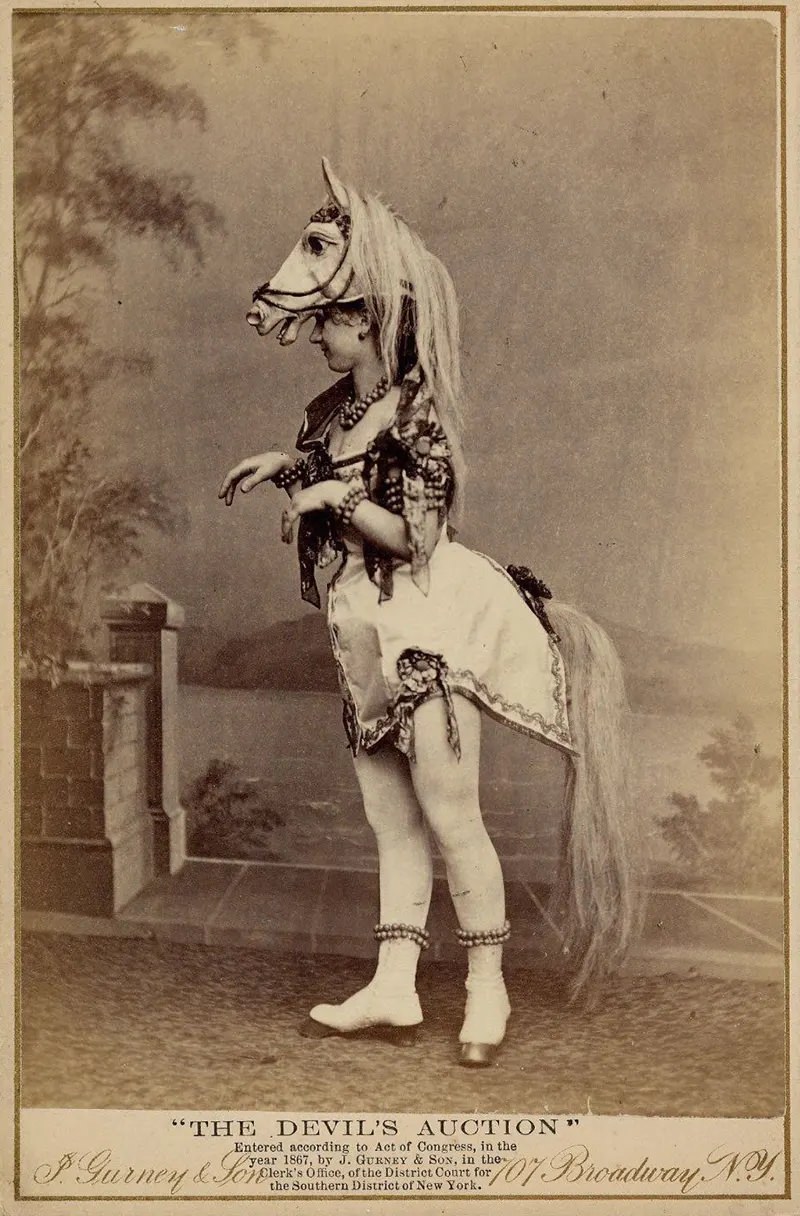
Eliza Blasina stands in profile, half performer and half playful illusion, wearing a striking horse-head headdress that turns a human silhouette into a theatrical creature. The studio backdrop—soft scenery and a hint of balustrade—frames her as though she has stepped onto a stage set, poised mid-act with bent wrists and a lifted posture that suggests dance or pantomime. Below, the caption “The Devil’s Auction” ties the portrait to a popular burlesque tradition of the era, where spectacle and character were as important as movement.
Her costume is short and fitted, trimmed with decorative edging and paired with a long attached horsetail that trails nearly to the floor, emphasizing motion even in stillness. Rows of round beads or bells circle her ankles, wrists, neck, and upper arm, the kind of accessories designed to catch light and sound with every step. White stockings and heeled boots complete the look, blending Victorian stage fashion with a deliberately comic, animal-inspired fantasy.
More than a novelty outfit, the image offers a window into 19th-century entertainment culture, when burlesque dancers used costume to parody, enchant, and advertise their versatility. The careful studio posing and crisp detailing suggest a photograph intended for promotion or collection, a keepsake that extended a performance beyond the theater. For historians of fashion and performance, Blasina’s horse-themed ensemble illustrates how the Victorian stage mixed ornament, humor, and daring design to hold an audience’s attention.