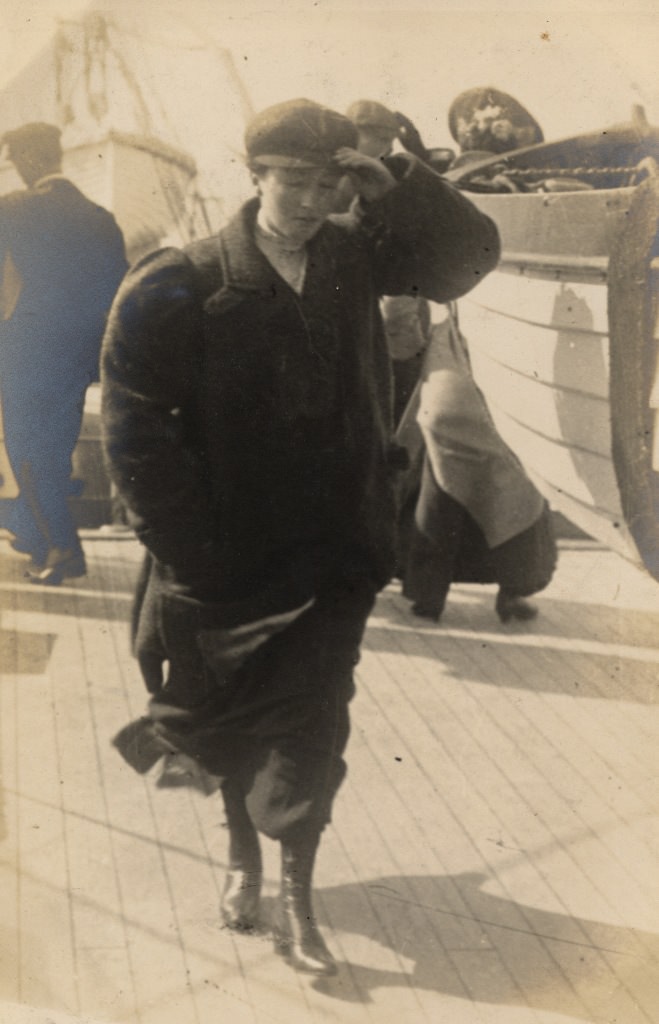
Wind pushes across the ferry deck as a young woman strides forward, one hand lifting to steady the brim of a flat cap. Her heavy, masculine-looking overcoat hangs straight and protective, a practical silhouette that reads more like maritime workwear than the frilled femininity often associated with early 20th-century seaside outings. The pose is candid and slightly defiant, caught mid-step, with the bright haze of sea air washing the scene in soft tones.
Behind her, the rail and lifeboat rigging suggest the everyday mechanics of passenger travel, while other figures blur into motion along the planked walkway. The setting feels transitional—neither fully city nor fully shore—capturing that liminal moment of crossing where clothing must answer to weather, spray, and the cramped life of a boat. Details like sturdy boots and the thick collar emphasize function over ornament, grounding the image in lived experience rather than studio display.
Such attire also hints at shifting fashion and cultural attitudes, when some women adopted tailored coats and hats associated with men’s wardrobes for comfort, mobility, or modern style. On a ferry, where gusts make short work of delicate trims, this kind of dress becomes both sensible and quietly expressive. For anyone searching Edwardian travel photography, seaside fashion history, or early street-style portraits on ships, the photograph offers a vivid glimpse of how identity and practicality met on the water.