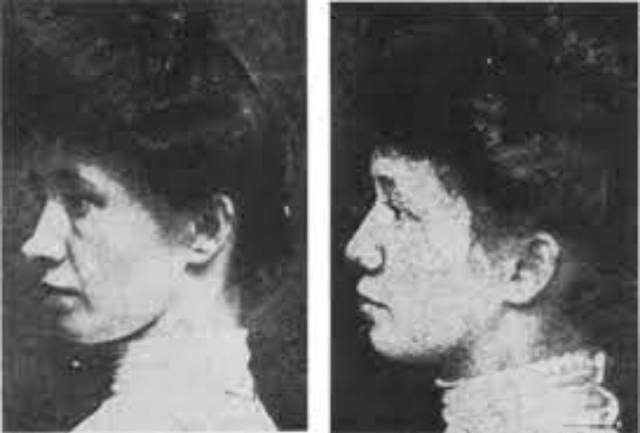
Side-by-side profile portraits place the viewer in the realm of early “before-and-after” medical imagery, where a woman’s face is presented with clinical simplicity and little distraction. The matching angle, plain background, and tight crop emphasize the nose and jawline, inviting comparison in the way physicians and patients of the era documented change. It’s the kind of stark presentation that helped make rhinoplasty legible to a wider public—proof offered in pixels and paper long before glossy advertising.
In the 1920s and 1930s, cosmetic surgery grew in visibility alongside shifting ideals of beauty shaped by fashion, film, and modern consumer culture. A profile like this speaks to how the nose became a focal point for “refinement,” with surgeons promising subtler contours that would read differently in photographs and on the street. The hair is pulled back and the expression remains neutral, reinforcing that the subject is being recorded not as a personality but as a set of features to be measured, adjusted, and displayed.
Behind the apparent straightforwardness lies a complicated history: early rhinoplasty was entwined with new surgical techniques, evolving anesthesia and antisepsis, and the social pressures that made altering one’s appearance feel necessary—or newly possible. These comparative portraits also reveal how medical documentation borrowed the visual language of fashion and publicity, turning personal anatomy into a narrative of transformation. For readers interested in vintage cosmetic surgery, 1920s beauty standards, and 1930s fashion culture, the image offers a small but telling window into how modern ideas of “improvement” were built.