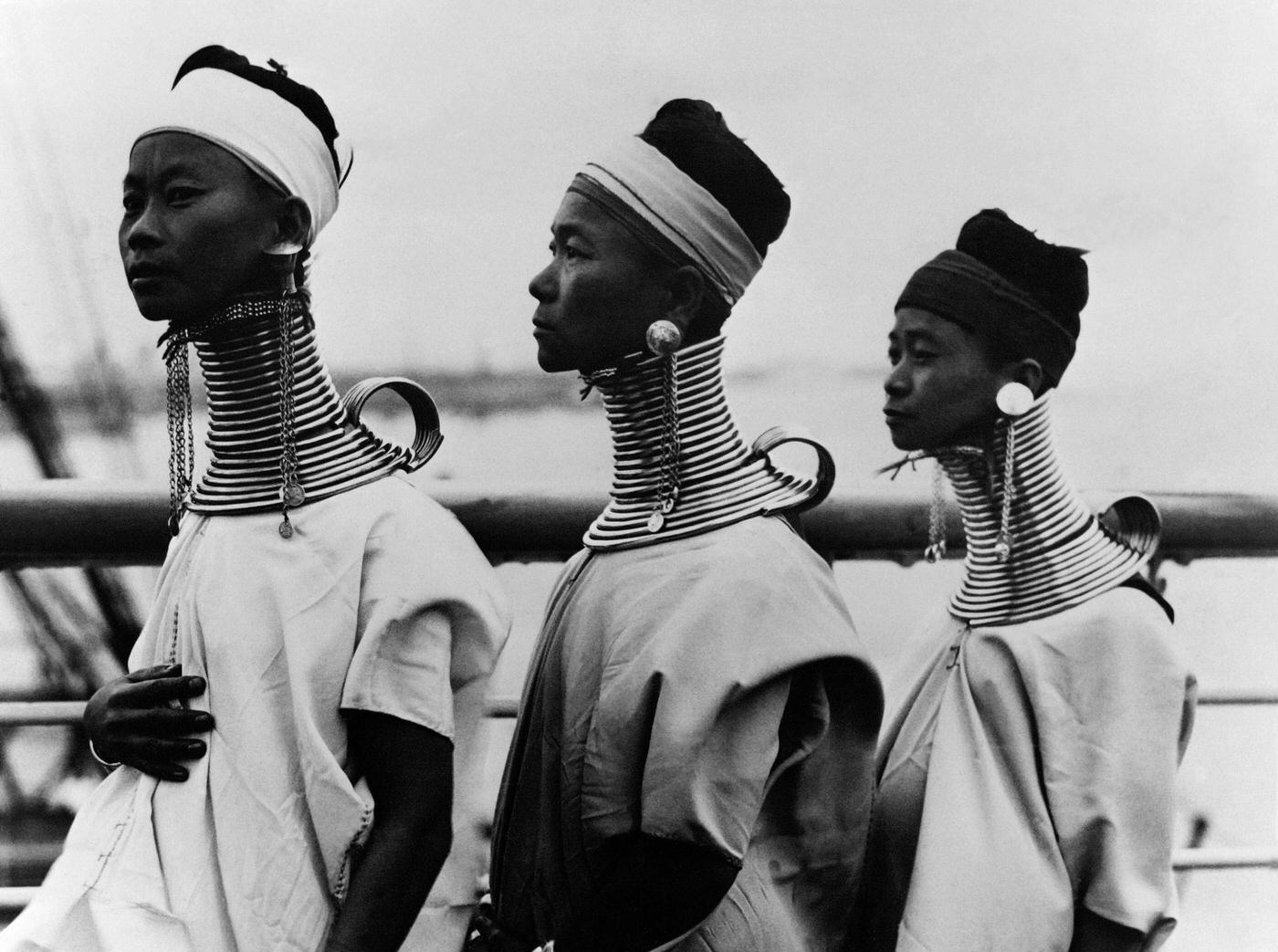
Three women stand in profile against a soft, indistinct horizon, their posture calm and self-possessed as their layered neck rings catch the light in clean, repeating bands. Each wears a wrapped headcloth and long earrings that fall toward the collar, adding movement and shimmer to the stillness of the pose. The photographer’s low-contrast background pushes attention to the sculptural silhouettes of ringed necks, draped garments, and the quiet intensity of their expressions.
Known widely as “giraffe women,” the Padaung—often associated with Kayan Lahwi communities—became emblematic in outsider accounts of the border mountains between Myanmar and Thailand. The coiled brass rings, built up over time, are not a costume for a single occasion but part of a lived tradition tied to beauty, identity, and social belonging, with variations visible in the number of coils and the fit at shoulder height. Here, the portrait’s careful alignment and side view read almost like an ethnographic study, yet the women’s gaze and composure resist being reduced to a curiosity.
Set in 1963, the image offers a window into fashion and culture in a region where upland life and borderland politics have long shaped daily experience, migration, and representation. It also reflects how mid-20th-century documentary photography framed Indigenous traditions for distant audiences—often emphasizing the spectacular detail while leaving names and personal stories unrecorded. For readers searching for historical photographs of neck rings, Kayan Lahwi traditions, and the Padaung women of Myanmar–Thailand, this scene remains a striking reminder that material adornment can carry history as surely as any written archive.