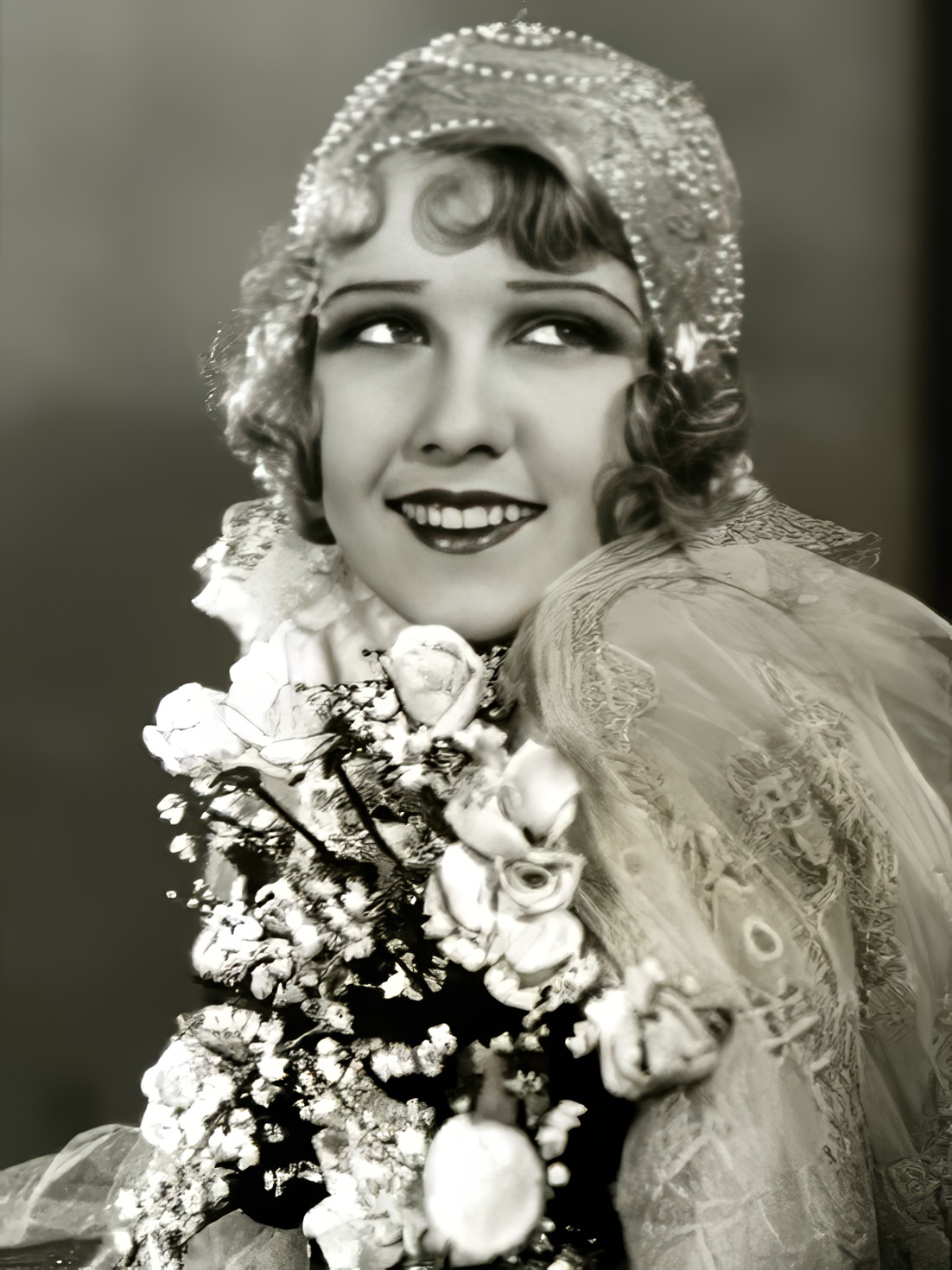
Anita Page appears here in a carefully staged studio portrait, her face turned slightly aside as if catching a thought just out of frame. A beaded cloche sits low on her finger-waved hair, while dark, sculpted eye makeup and a glossy smile give the look its unmistakable 1920s–early 1930s Hollywood polish. The soft-focus lighting smooths the backdrop into a haze, making her expression and the crisp line of her brows the real centerpiece.
Feathers and airy lace spill across her shoulders, and a dense cluster of flowers rises in the foreground like a romantic prop from a premiere night. The contrast between delicate textures—sparkling beadwork, sheer fabric, and velvety petals—speaks to the era’s love of glamour as performance. Even without a set or dialogue, the pose does what silent-film portraiture did best: it tells a story through mood, styling, and a star’s practiced control of the camera.
Page’s career arc, beginning in silent films and continuing smoothly into the “talkies,” makes this kind of image more than fashion; it’s a window into an industry reinventing itself. Studios sold audiences a modern ideal—youthful, stylish, and confident—at the very moment technology demanded new kinds of screen presence. For readers exploring flapper-inspired beauty, classic film history, or the transition from silent cinema to sound, this portrait distills the allure that kept Anita Page in the spotlight as Hollywood found its voice.