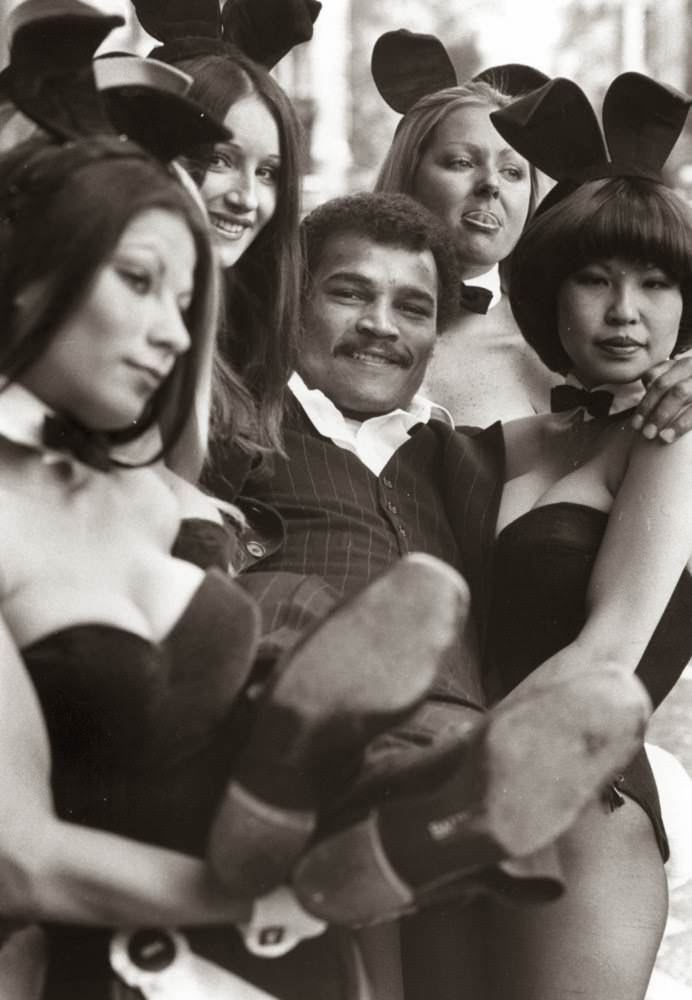
Grinning at the center of the frame, champion British boxer John Conteh leans back as a cluster of Playboy Bunny Girls lift and crowd around him, their satin corsets, bow ties, cuffs, and high ear headbands forming an instantly recognizable 1970s pop-culture uniform. The composition is tight and celebratory, with faces pressed close and the boxer’s relaxed posture suggesting a staged moment meant for maximum publicity. Even without a visible venue or signage, the scene reads like a glamorous promotional snapshot where sport, nightlife, and celebrity culture overlap.
Costume and pose do much of the storytelling here: the Bunnies’ polished styling signals brand discipline and show-business spectacle, while Conteh’s dressed-up look and easy smile sell the idea of the fighter as a charismatic star beyond the ring. The women’s varied expressions—some laughing, some coolly composed—add texture, hinting at the performance required in such settings as well as the candid seconds between it. In the foreground, the soft blur of a figure and the angle of Conteh’s legs emphasize motion and closeness, as if the photographer stepped into the crowd rather than observing from a distance.
Placed in 1974, the photograph becomes a vivid time capsule of fashion and culture: a period when boxing champions were marketed alongside the era’s most famous lifestyle imagery, and when Playboy aesthetics traveled widely through media and events. For readers drawn to retro photography, 1970s glamour, or the history of British boxing, it offers a compact lesson in how celebrity was manufactured—through choreography, costume, and a camera hungry for a story. The result is both playful and revealing, capturing not a fight, but the surrounding theatre that helped define the decade’s public faces.