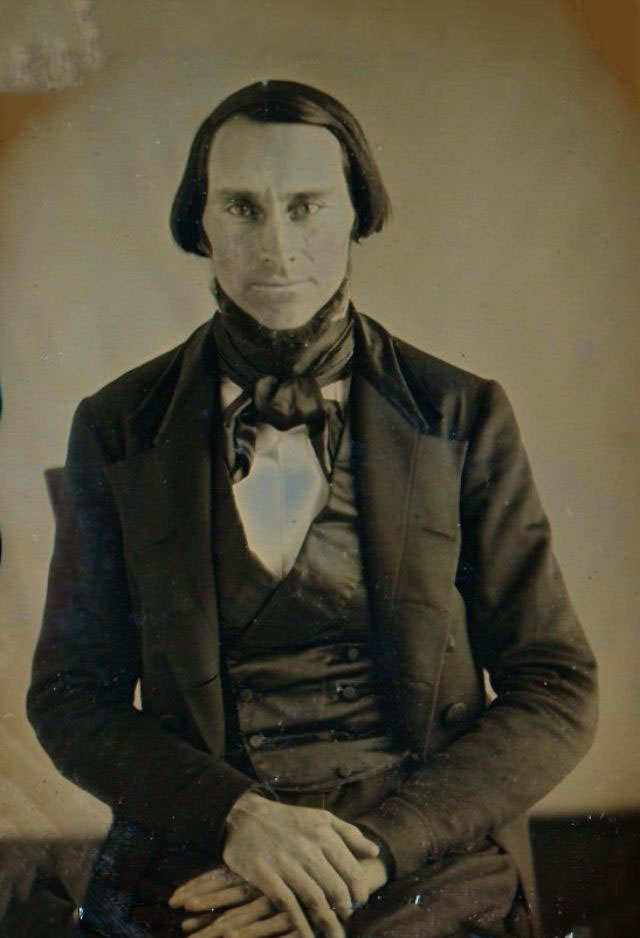
A stern, studio-posed gentleman meets the viewer head-on, his clothing as carefully arranged as his hair. The dark coat and buttoned waistcoat form a formal silhouette, while a neatly tied cravat draws the eye to the clean lines of the face. Set against a plain backdrop, the portrait relies on texture—polished fabric, subtle sheen, and the soft fall of light—to convey Victorian respectability.
Most striking is the hairstyle: a precise center part with smooth, glossy hair shaped close to the head, the sides sweeping down toward the cheeks in a controlled, almost architectural curve. This kind of grooming speaks to an era when men’s hair was often disciplined with pomade or oil, emphasizing symmetry and restraint over casual movement. With no heavy beard to compete for attention, the haircut becomes the defining feature, turning the portrait into a small lesson in iconic Victorian men’s hairstyles.
As a piece of fashion and culture, the image suggests how personal style functioned as social language in the nineteenth century—where tailoring, neckwear, and hair together signaled refinement and self-command. The careful presentation makes it easy to imagine why such looks endure in galleries of Victorian men’s hairstyles and trends, inspiring modern searches for period-accurate hair, classic side shapes, and formal gentleman styling. Even without a named sitter or specified place, the portrait reads clearly as a document of grooming ideals and the era’s quietly competitive elegance.