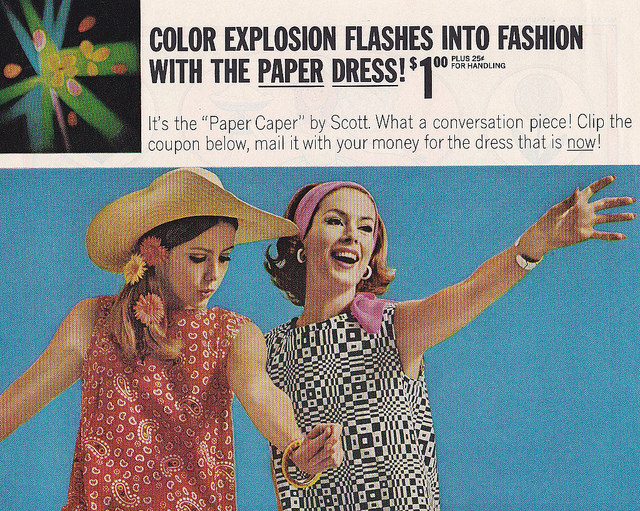
Bright ad copy shouts “COLOR EXPLOSION FLASHES INTO FASHION WITH THE PAPER DRESS!” and that breathless promise says a lot about how 1960s style was sold—fast, fun, and meant to be talked about. The illustration pairs bold pattern with even bolder optimism, turning a disposable idea into a “conversation piece” that could be ordered by mail with a clipped coupon. Even the fine print about handling hints at the novelty: this wasn’t just a new hemline, it was a new kind of product.
Two models are drawn mid-gesture against a clean blue backdrop, their looks echoing the era’s love of graphic design and pop color. One wears a black-and-white checkerboard print with a headband and oversized bow, while the other leans into a patterned red shift with a wide-brim hat and big floral earrings—accessories that add personality even when the dress itself is meant to be temporary. The styling suggests youth culture’s appetite for playful reinvention, where outfits could be as changeable as a playlist.
Paper dresses occupy a quirky corner of fashion history, sitting at the crossroads of consumer convenience, advertising spectacle, and mid-century experiments with new materials. They were marketed as modern, inexpensive, and easy to order, yet their very disposability exposed the limits of the trend. For readers interested in 1960s fashion and culture, this period advertisement is a crisp snapshot of how novelty became mainstream—briefly, loudly, and with patterns designed to pop at first glance.