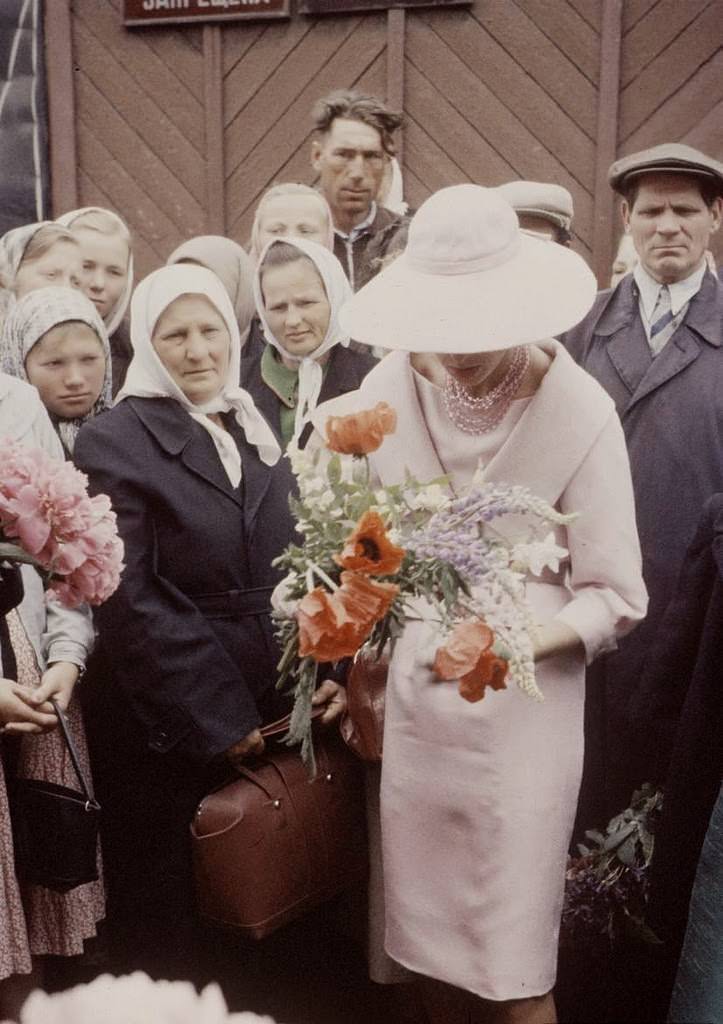
Against a backdrop of workaday coats and headscarves, a woman in a pale, impeccably tailored outfit steps forward like a visiting comet, her wide-brim hat lowering her gaze as she accepts a bouquet of fresh flowers. The scene is crowded and close, faces pressed in from every side—curious, guarded, amused—while the soft elegance of her silhouette reads as unmistakably Western couture. Even without a runway, the contrast between fabric, posture, and polish turns an ordinary street moment into a fashion event.
The title’s “1959 fashion shock” makes sense in the smallest details: layered pearls at the neck, clean lines through the sleeves, and the deliberate simplicity of a dress designed to look effortless. Around her, people wear practical clothing suited to Soviet everyday life, their expressions suggesting that they know they’re witnessing something rare. It’s not just a meeting of styles, but a collision of visual languages—utility and refinement, scarcity and display—played out in the space between spectators and the woman at center.
“Dior in Moscow” has become a shorthand for cultural thaw and soft power, and this photo captures the human side of that story: attention, bewilderment, and fascination shared in real time. Fashion here functions as diplomacy, advertisement, and provocation all at once, carried not by slogans but by cut, color, and a hat brim casting a private shadow in a public crowd. For readers interested in Cold War culture, Soviet streets, and the history of haute couture, this image offers a vivid reminder that clothing can reshape an atmosphere as quickly as any headline.