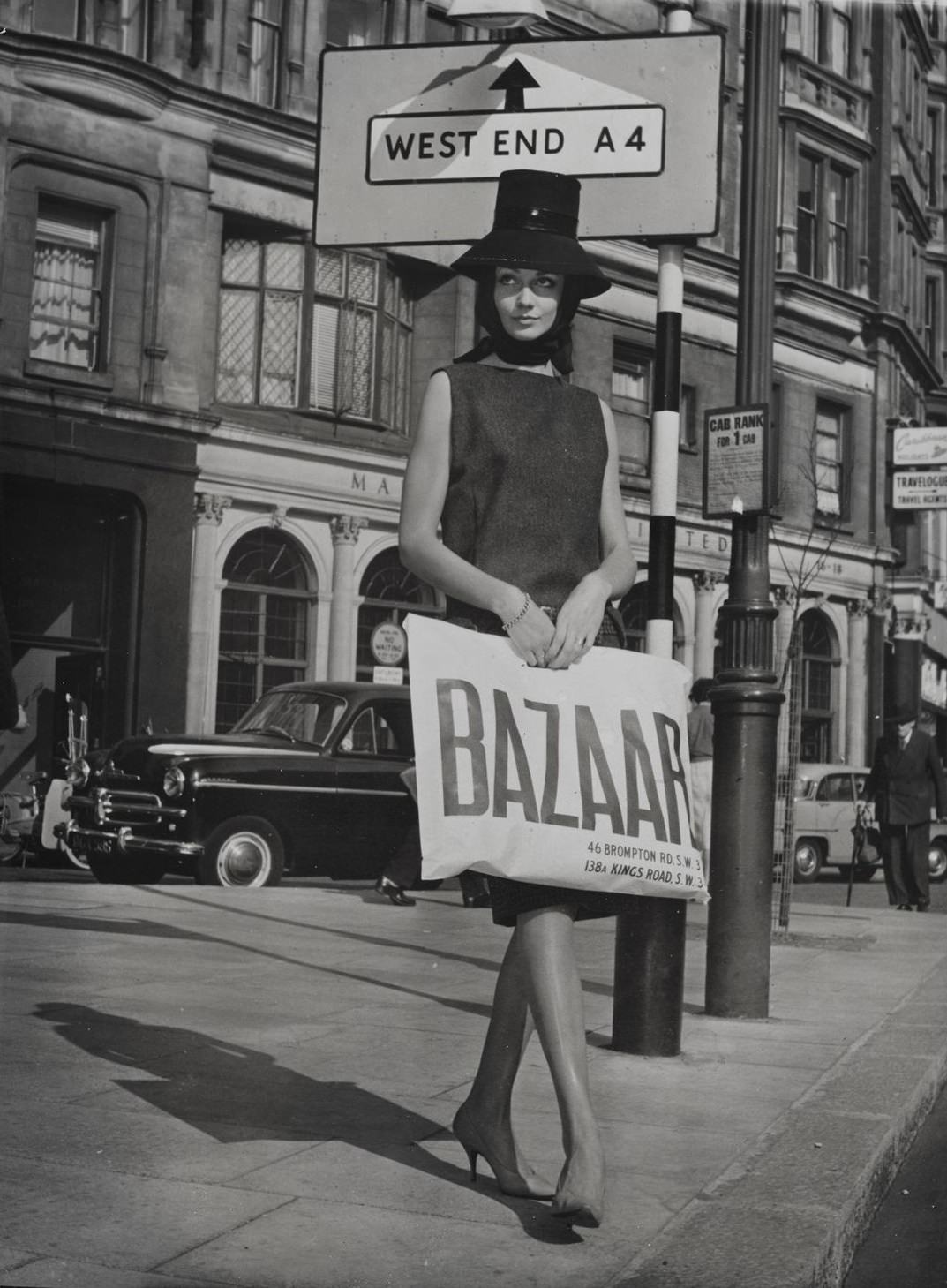
Poised beneath a road sign pointing toward “WEST END A4,” a young model turns a city pavement into a runway, her tall hat and sleek sleeveless shift dress sharpening the modern silhouette that was beginning to redefine late-1950s style. The look is crisp and graphic, made even bolder by the dramatic contrast of her dark outfit against the pale stone façades behind her. With legs crossed and chin slightly lifted, she holds the camera’s attention the way the new boutiques of the King’s Road would soon hold London’s.
In her hands sits a large shopping bag printed with the emphatic word “BAZAAR,” the typography functioning as both advertisement and cultural signal. The bag’s printed addresses—Brompton Road and King’s Road—anchor the moment in the geography of fashionable London, where retail was evolving into lifestyle and identity. Details at street level—polished cars, kerb lines, and the steady rhythm of everyday traffic—quietly underline how fashion photography borrowed the ordinary city to sell a more daring future.
Behind this carefully staged pose lies the atmosphere hinted at in the title: Bazaar and the nearby Markham Arms, names synonymous with the social life that clustered around Chelsea’s shopping streets. The photograph belongs to the pre-Swinging Sixties threshold, when hemlines were creeping upward, youth culture was gathering confidence, and boutiques were learning to speak in bold, memorable branding. For anyone tracing Mary Quant’s orbit and the King’s Road’s role in British fashion history, the image reads as an early chapter in the story of the mini-skirt era—still restrained, already unmistakably new.