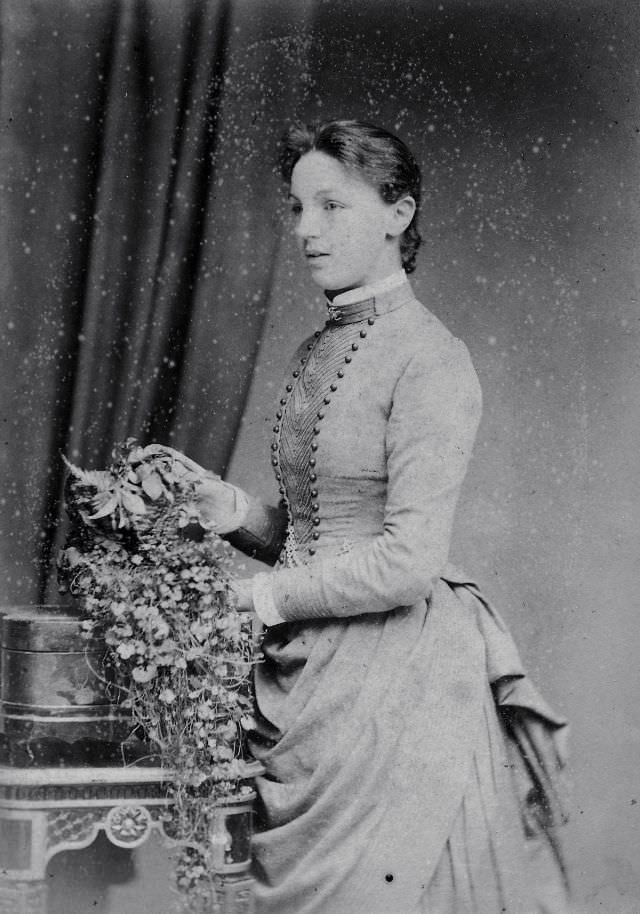
Poised in three-quarter profile, a Victorian woman stands beside an ornate studio table draped with trailing flowers, her gloved hands gently gathering the bouquet as if pausing mid-conversation. The photographer’s painted backdrop and heavy curtain frame her like stage scenery, while her neatly swept hair and calm, distant gaze lend the portrait an air of practiced composure. Even in a formal setting, small details—soft fabric folds, a crisp collar, the careful arrangement of greenery—give the scene a lived-in elegance.
Her fitted bodice, fastened with a long row of buttons, hints at the late 19th-century silhouette shaped by the corset: an emphasized waist, a smooth torso line, and a skirt arranged to fall in disciplined drapery. Though the corset itself remains hidden as an indispensable undergarment, its influence is unmistakable in the garment’s tailored seams and the controlled posture the pose encourages. Fashion in this era was architecture as much as decoration, relying on layers, structure, and skilled dressmaking to create an ideal figure for public display.
Portraits like this functioned as both personal keepsakes and cultural evidence, preserving how Victorian femininity was styled, performed, and photographed. The image speaks to the everyday realities behind “beautiful women in tight corsets”—comfort negotiated for appearance, clothing engineered to signal respectability, and studio photography used to fix these choices into memory. For readers exploring Victorian fashion history, corset culture, and late-19th-century women’s dress, the photograph offers a quietly persuasive glimpse of how undergarments shaped the look of an age.