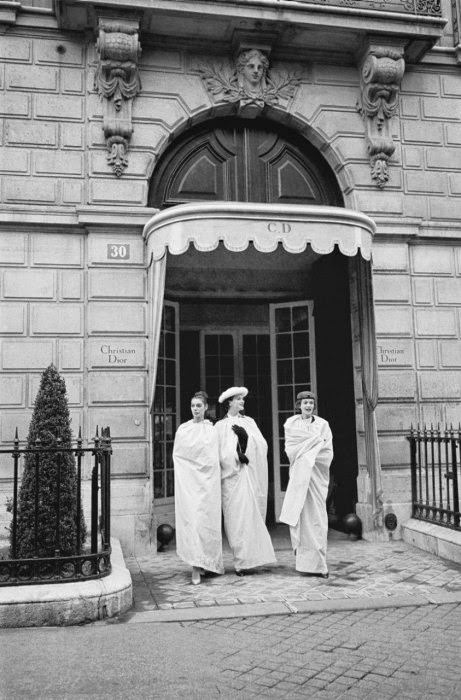
Outside the arched entrance marked “C.D.” and flanked by discreet “Christian Dior” plaques, three models step onto the pavement wrapped in voluminous coverings that hide everything beneath. The scene is poised and theatrical: a grand townhouse façade, iron railings, and a guarded threshold between the private world of the salon and the public street. Even without seeing the garments, you feel the charge of haute couture in motion—luxury rendered as ritual.
In the Autumn–Winter 1953 haute-couture collection era, secrecy was part of the business model as much as silk and stitching. Designers and houses worked to prevent new outfits from being copied, and these street-ready shrouds acted like moving vaults for silhouettes not yet meant for rivals’ eyes. The coverings turn the models into anonymous carriers of ideas, reminding us how valuable a cut, a line, or a drape could be in the competitive postwar fashion economy.
Fashion history often celebrates the finished look on the runway, yet this photograph lingers on the backstage logistics of style: protection, timing, and control. The contrast between the sober wraps and the glamorous reputation of couture hints at the industry’s dual nature—public fantasy built on private discipline. For readers interested in Christian Dior, 1950s Paris fashion culture, and the hidden mechanics of haute couture, this moment on the doorstep says as much as any catwalk.