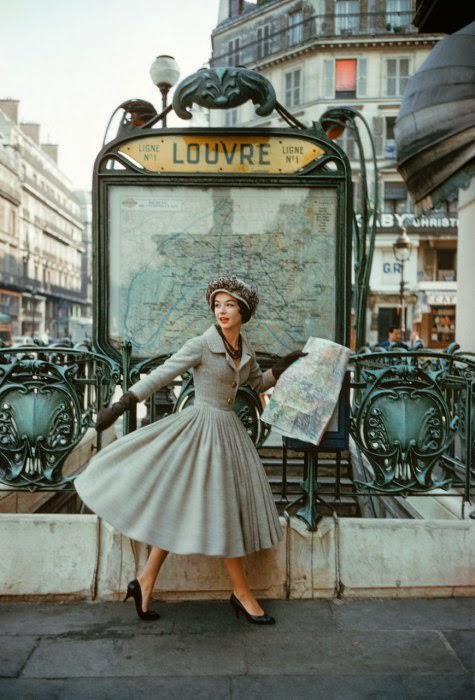
At the entrance to the Louvre Métro, a poised model turns the everyday bustle of Paris into a runway, pausing beside an Art Nouveau railing and a large city map. Her tailored jacket and full, swinging skirt read instantly as mid-century couture—structured at the waist, generous in volume, and finished with gloves, a small hat, and sleek heels. Even the street signage and stone façades behind her amplify the sense of postwar confidence, when elegance was designed to be seen in motion.
Palais de Glace, the name given to this Spring–Summer 1957 haute-couture look, feels fitting for a silhouette that seems both crisp and fluid. The softly reflective tone of the ensemble and the careful styling suggest a house at the height of its power, where precision cut meets theatrical presence without tipping into excess. Held against the map like a prop, the paper becomes part of the story: couture as a companion to modern life, navigating the city while remaining unmistakably rarefied.
Fashion historians return to images like this because they show how couture communicated beyond the salon—through streets, stations, and the public eye. The photograph’s color palette and urban setting underscore a particular 1950s ideal: polished, practical-looking sophistication that nonetheless depends on masterful construction. For readers searching Christian Dior-era glamour, Paris couture photography, or the Spring-Summer 1957 haute-couture collection, this scene offers a vivid window into a moment when style and city were inseparable.