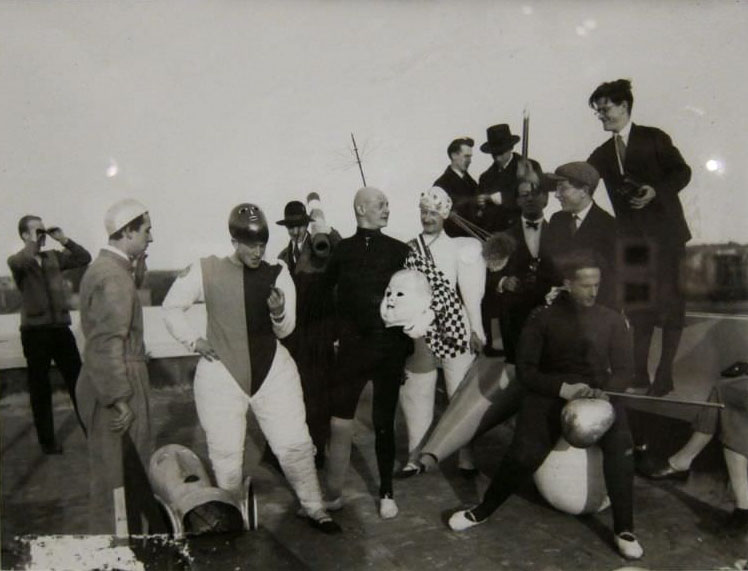
Against an open sky, a mixed group of performers and onlookers crowds together, some in everyday suits and caps, others costumed in startling, geometric disguises. Several figures wear smooth, mask-like faces and fitted bodysuits, while bulbous, padded forms at the hips and legs turn the human silhouette into something closer to sculpture. The contrast between ordinary clothing and avant-garde stagewear makes the scene feel like a rehearsal spillover—art interrupting the street with a dose of playful modernism.
Near the center, diamond patterns, stark black-and-white panels, and exaggerated volumes evoke the design language often associated with the Triadic Ballet’s machine-age fantasy. A few props and rounded shapes sit on the ground like unfinished pieces of a moving set, suggesting choreography built from objects as much as from bodies. Even in a still image, the poses hint at dance: a casual lean here, a turned shoulder there, as if the performers are mid-transition between tableau and motion.
Roaring Twenties fashion and culture hover over the photograph in the sharp tailoring of the spectators and the experimental daring of the costumes, capturing a moment when theater, visual art, and design eagerly overlapped. The masked faces feel deliberately impersonal, emphasizing form, pattern, and geometry over individual identity—an aesthetic that resonated with the era’s fascination with abstraction and new technologies. For modern viewers searching the history of avant-garde performance, this image reads like a portal into a surreal stage world where dancers become living shapes.