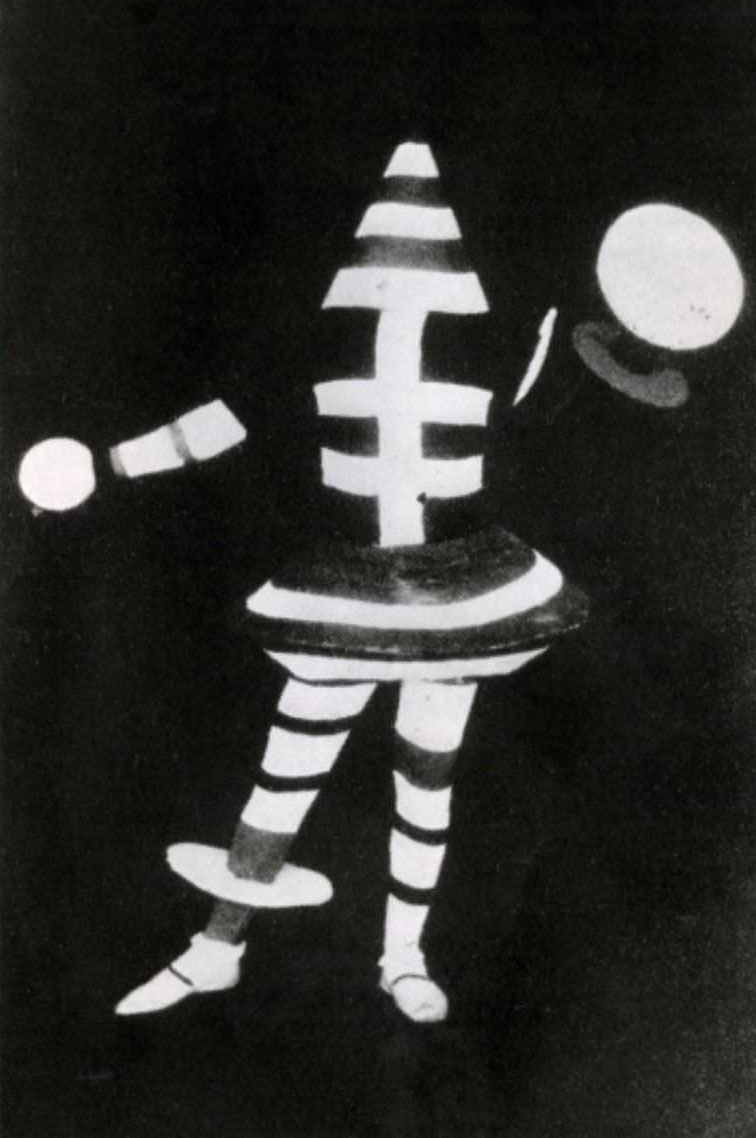
Against a deep, stage-like black backdrop, a single dancer becomes an abstract construction of circles, cones, and stacked bands, as if geometry itself has learned to move. The costume’s bold stripes and rigid contours turn the body into a living sculpture, with a tiered, spinning top silhouette at the torso and a rounded disc hovering like a floating hat or planetary moon. In this stark light-and-dark contrast, the human figure is deliberately disguised, inviting the viewer to read motion through shape rather than face.
Surreal theater and early modern design sensibilities meet in the visual language of The Triadic Ballet, where fashion is less about fabric drape and more about engineered form. The striped legs and segmented limbs suggest mechanical precision, while the curved skirt-like ring and sculptural headpiece echo the era’s fascination with futurism, avant-garde choreography, and machine-age rhythm. Even in a static photograph, the pose hints at measured steps and playful rotations, a dance built from balance, symmetry, and controlled exaggeration.
In the broader Roaring Twenties culture of experimentation, such imagery reflects a moment when performance, costume design, and fine art blurred into a single avant-garde statement. The minimalist set and graphic costume amplify an Art Deco-adjacent taste for clean lines, bold contrast, and stylized spectacle, making the scene instantly recognizable to anyone searching for modernist ballet history or 1920s fashion and culture. What remains most striking is the way the dancer is transformed into an emblem—part puppet, part architectural model—capturing the period’s hunger for new forms of beauty.