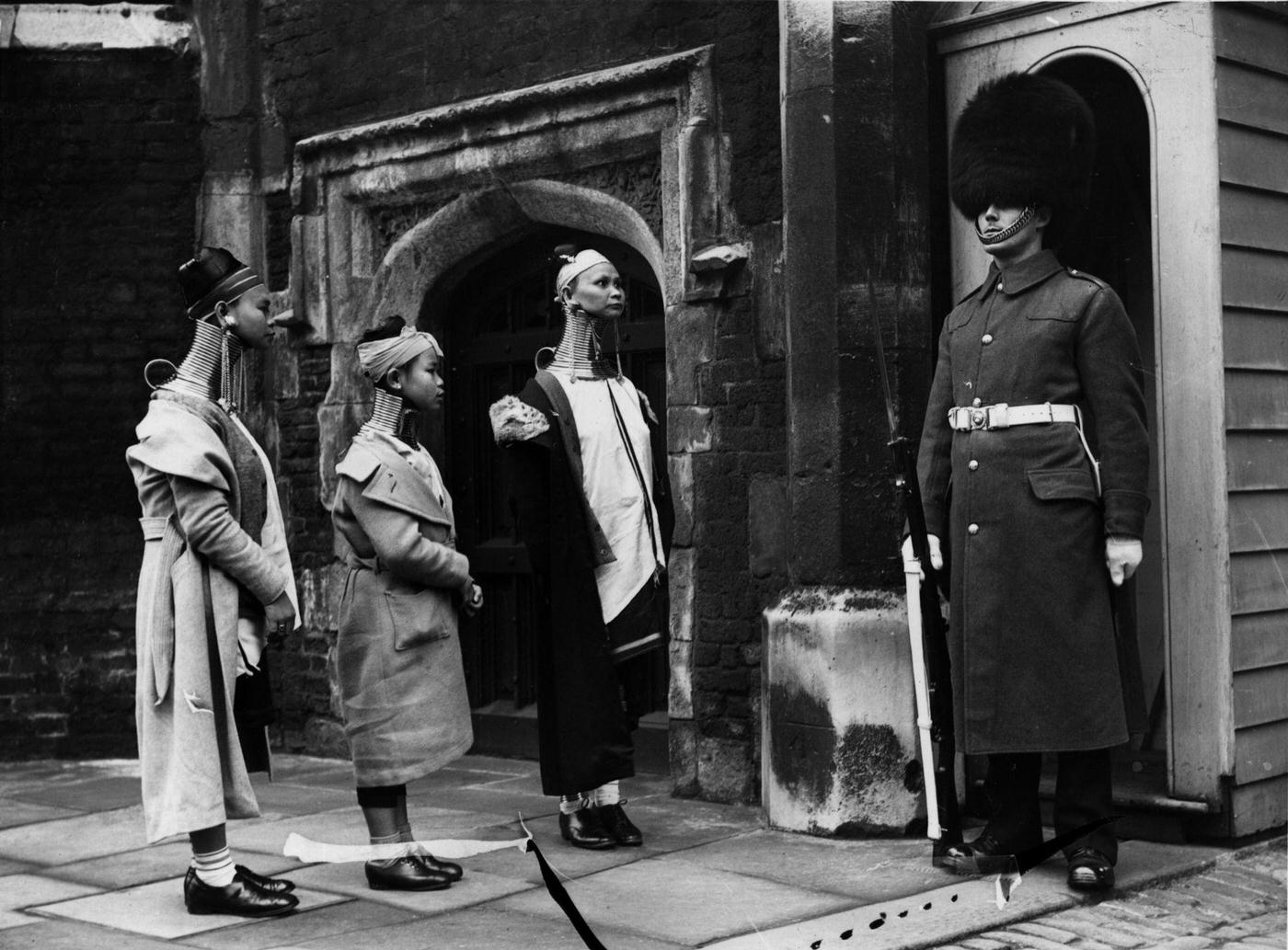
Under a heavy stone archway, three women from Burma pause on a London pavement, their silhouettes defined by stacked neck rings and layered coats that hint at travel and chilly weather. The metal coils rise in neat bands to the jawline, paired with headwraps and practical shoes, while their faces turn toward a figure who seems as unfamiliar to them as they are to the city around them. Brick walls and worn masonry frame the moment, giving the scene a distinctly old-world London texture.
Opposite them stands a soldier on guard, rigid beside a small sentry box, his long coat and belt immaculate and his tall bearskin hat towering into the frame. A rifle rests upright at his side, emphasizing ceremony and authority as much as security. The women’s attentive posture and the soldier’s disciplined stillness create a quiet standoff of gazes—curiosity meeting protocol—captured in a single, balanced composition.
London in 1935 was a crossroads of empire, tourism, and public spectacle, and the photograph reads like an encounter staged by circumstance: traditional adornment meeting British military pageantry. The title’s phrase “giraffe necked women” reflects the era’s sensational language, yet the image itself offers more than novelty, showing individuals observing and being observed in equal measure. For readers searching fashion and culture history, Kayan-style neck rings, and the visual record of Burma-linked communities abroad, this scene preserves an uneasy, fascinating snapshot of how difference was displayed, negotiated, and remembered.