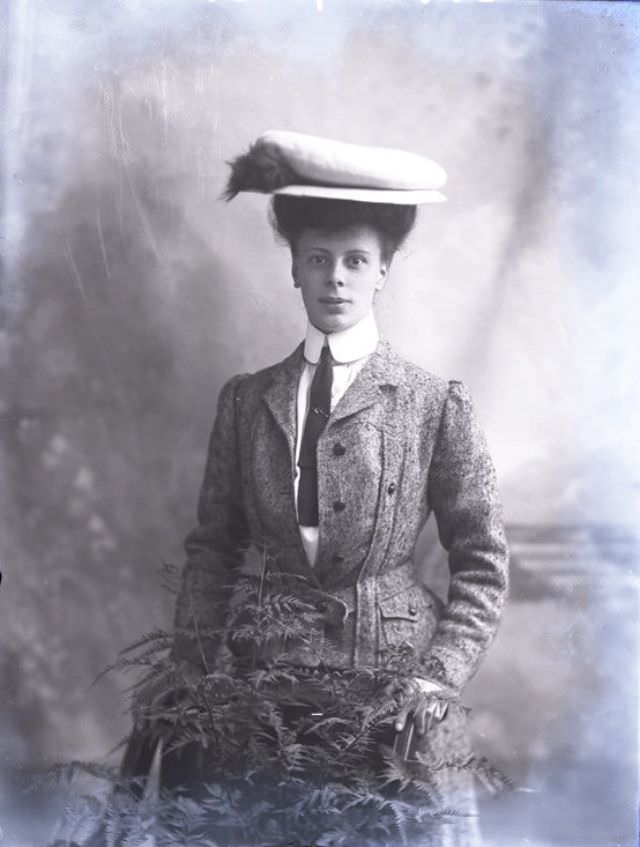
Poised before a softly painted studio backdrop, Miss Foord meets the camera with a calm, direct gaze on December 11, 1906. Her Edwardian hat—broad, flat, and dramatically perched above a high coiffure—signals the era’s love of bold millinery silhouettes, where height and breadth balanced one another like architecture. The gentle blur around her lends the portrait a misty, dreamlike quality typical of early studio photography, designed to flatter the sitter and smooth the scene into elegance.
A tailored jacket in textured fabric shapes her figure with a fitted waist and prominent buttons, reflecting the period’s shift toward crisp, masculine-inspired lines in women’s fashion. A high, stiff collar and dark tie or neckwear emphasize formality and modernity, suggesting a woman comfortable with contemporary style rather than purely decorative dress. In the foreground, leafy greenery—likely a studio prop—adds a natural motif that softens the strict tailoring and frames her hands with a hint of cultivated refinement.
Even without a named location, the portrait reads as a small document of Fashion & Culture: a moment when women’s clothing negotiated tradition, practicality, and display. The hat, in particular, embodies Edwardian-era statement dressing, built to be noticed in public spaces and preserved in photographs like this one. As a historical image, it offers rich visual evidence for researchers and enthusiasts tracing early 20th-century women’s attire, studio portrait conventions, and the social language of dress.