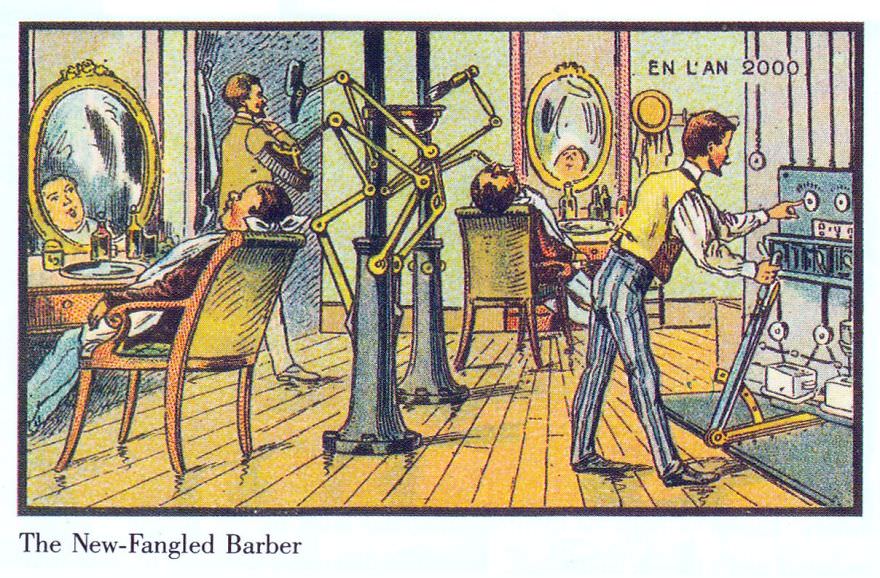
Salon chairs line a polished floor while customers recline with the trusting stillness of people who have handed their appearance over to the future. In the middle of the scene, a tall contraption sprouts jointed arms like an oversized mechanical insect, poised to fuss over hair with the precision of gears and levers. The captioned idea of a “new‑fangled barber” leans hard into humor, turning everyday grooming into a spectacle of modern invention.
Against the mirrors and bottles, the illustrator stages a playful collision between comfort and automation: human bodies stay limp while machines do the work. A man at the right operates a control console, suggesting that even “robotic hairdressers” still need an attendant to pull the right handles and keep the apparatus in line. The phrase “EN L’AN 2000” in the artwork points to a once-fantastical tomorrow, when barbershops might run on engineered efficiency rather than steady hands and small talk.
What makes this historical image so SEO-friendly for topics like retro futurism, early predictions of robotics, and the history of barbering is its mix of optimism and gentle satire. It imagines the barbershop as a testing ground for automation, where convenience and novelty matter as much as the haircut itself. Funny on the surface, the scene also preserves an older generation’s curiosity—half wonder, half wink—about how machines might reshape even the most personal routines.