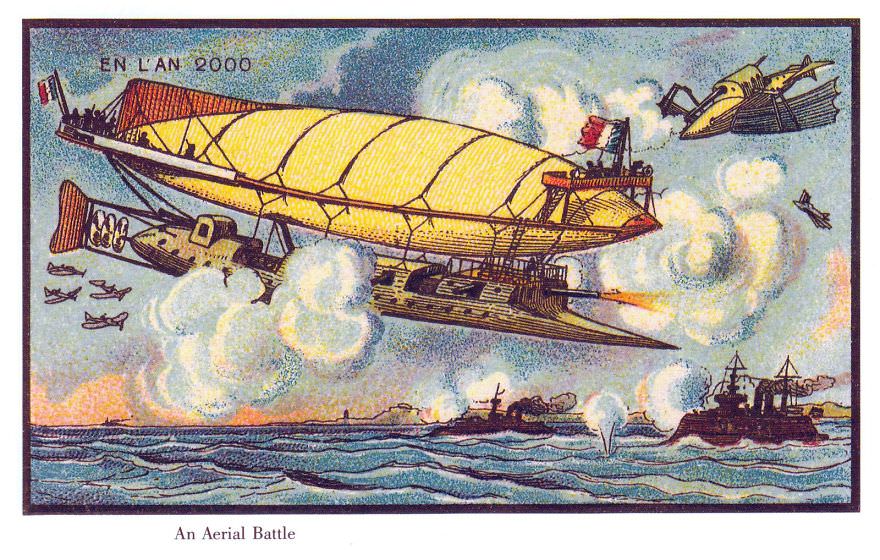
Over a choppy sea, a bulbous airship dominates the sky while smaller aircraft dart around it like angry wasps. Smoke blooms in pale clouds, and a streak of flame suggests a weapon fired from the flying leviathan as warships below trade their own volleys. Printed text in French—“EN L’AN 2000”—frames the scene as a vision of the future, turning aerial combat into a colorful, almost theatrical spectacle.
The title, “The War in the Air,” fits this illustration’s fascination with height, speed, and new machines that promised to remake battlefields. Dirigibles and early airplanes share the same airspace here, a reminder that people once imagined tomorrow’s wars as contests between rival inventions, not settled technologies. Even the caption “An Aerial Battle” reads like a confident announcement that warfare had already migrated upward.
What makes the piece memorable is how it balances menace with a strange humor: the action is intense, yet the exaggerated forms and bright palette feel closer to a postcard than a battlefield report. As a historical image, it works beautifully for readers searching for early aviation art, dirigible warfare imagery, and retro “future war” predictions—an artifact of the moment when the sky became the newest frontier for fear, wonder, and imagination.