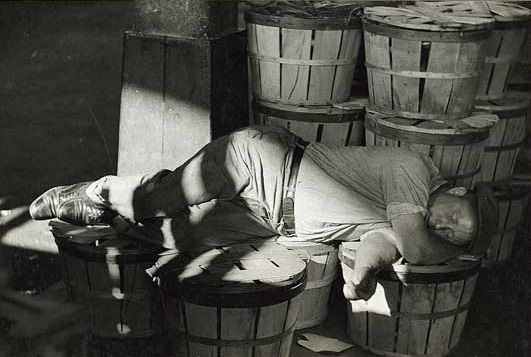
Wedged among stacked wooden fish tubs, a market worker has surrendered to exhaustion, using the rim of a barrel as a makeshift pillow while one arm hangs toward the floor. Hard light cuts across the scene, catching the curve of the containers and the slack posture of sleep, while the shadowed corners hint at the early hour and the long shift behind it. The title’s wink—“Sleeping with the fishes”—lands because the setting is so unmistakably a working fish market, where rest comes wherever it can.
Baltimore’s fish market in 1938 wasn’t just a place to buy seafood; it was an engine room of the waterfront economy, noisy and damp, filled with heavy lifting, quick sorting, and the constant churn of deliveries. The barrels and baskets suggest the practical infrastructure of the trade, built for hauling and storage rather than comfort, and the worker’s clothes read as utilitarian, ready for grime and cold. It’s an unguarded moment that quietly documents labor as much as commerce, offering a glimpse of how physical the job could be.
Humor surfaces first, but the longer you look, the photo becomes a small portrait of endurance—how the body steals a break even in the middle of the workday’s mess. For anyone searching for Baltimore history, Great Depression–era work culture, or candid street photography from the 1930s, this image delivers a vivid, human-scale story without needing a single posed smile. In the end, it’s a reminder that behind every bustling market scene were people catching breath wherever there was room.