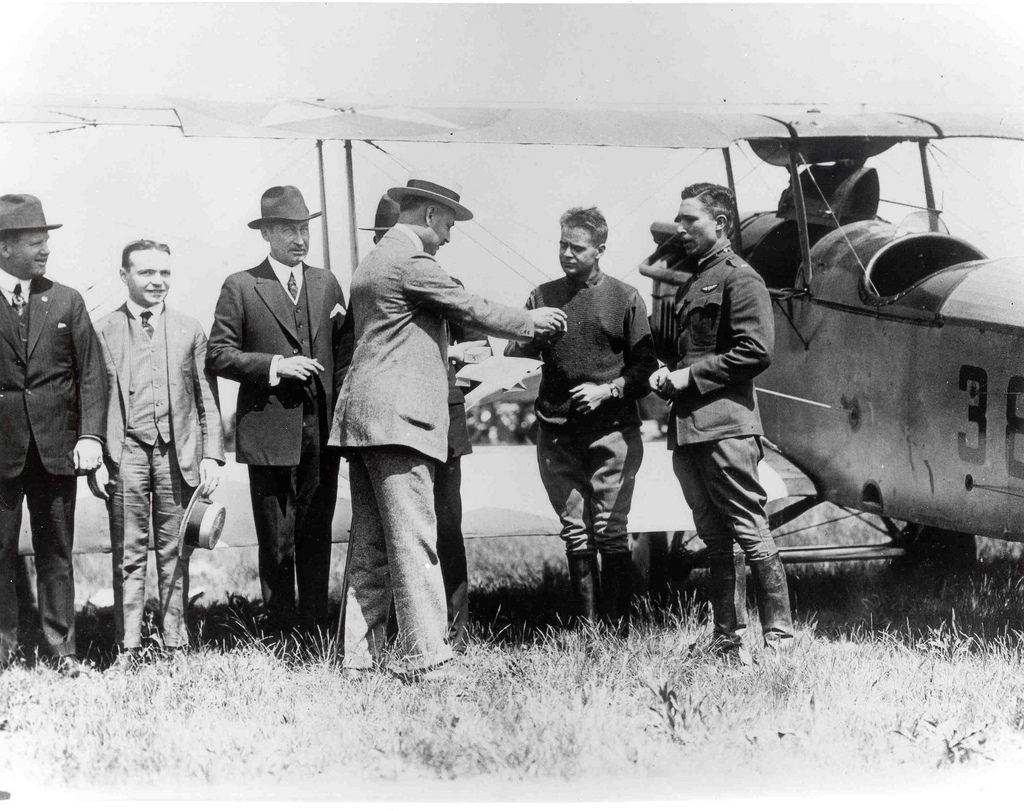
On May 15, 1918, the inauguration of U.S. airmail service brought politicians, postal officials, and aviators together on an open field beside a sturdy biplane. In the photograph, suited men in hats stand shoulder to shoulder with uniformed flyers, their attention fixed on a small handoff at center—an everyday gesture made momentous by the promise of faster communication. The aircraft’s fabric-covered wings and exposed framework hint at how new and experimental long-distance flying still was, even as the nation prepared to trust it with the mail.
Airmail was more than a novelty; it was a practical test of aviation as a public utility, turning inventions into infrastructure. Scenes like this capture the blend of ceremony and risk that defined early flight, when routes, weather, and reliability were still being mastered one trip at a time. The mix of formal attire and flight gear underscores the partnership needed to make the service work: government organization, postal logistics, and pilots willing to fly on demanding schedules.
Viewed today, the image reads as an origin story for modern air transportation and time-sensitive delivery, linking the early twentieth century’s engineering leaps to the world of overnight shipping and global networks. The inauguration of U.S. airmail service in 1918 signaled confidence that airplanes could shrink distances and connect communities with unprecedented speed. For readers interested in aviation history, postal history, and American inventions, this photo preserves a pivotal moment when the future arrived on canvas wings.