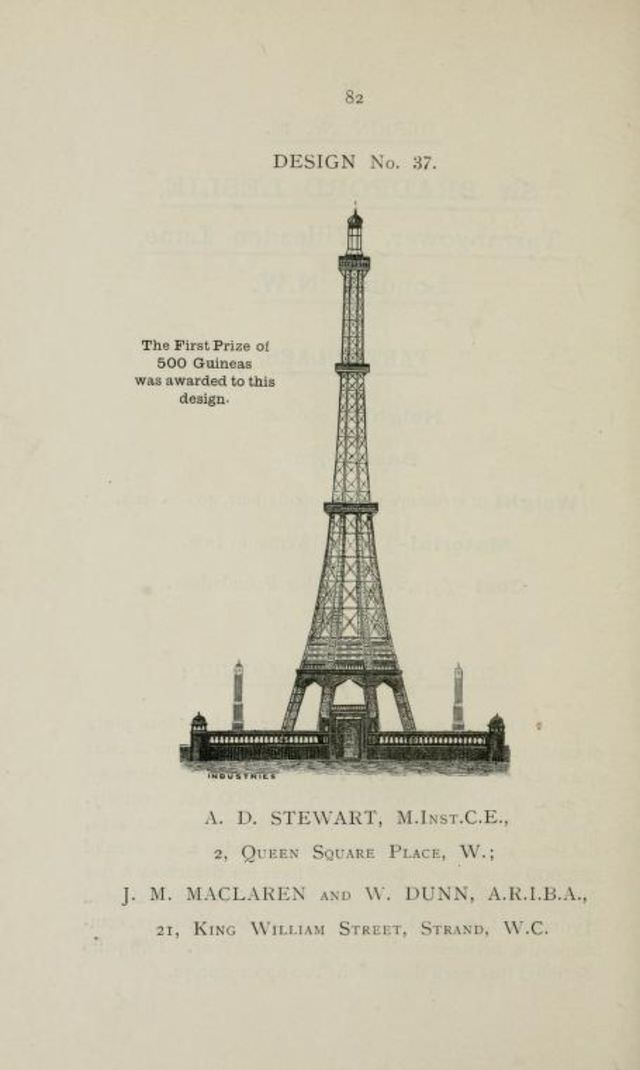
Centered on the page beneath the title “DESIGN No. 37.” stands a daring lattice tower proposal, drawn with the crisp confidence of an engineering plate. A note beside the structure announces, “The First Prize of 500 Guineas was awarded to this design,” hinting at a competitive moment in the history of inventions when paper plans promised to reshape skylines. Even without modern context, the tall, tapering form and its airy ironwork evoke the era’s fascination with height, strength, and industrial showmanship.
Look closely and the draftsmanship becomes the story: tight cross-bracing, a pronounced mid-level platform, and a base framed by low buildings and flanking pillars, all rendered to emphasize stability as much as spectacle. The composition reads like a pitch to judges and patrons—part technical drawing, part advertisement—where scale and symmetry were meant to reassure viewers that bold innovation could be built. As an artifact, it reflects how new structural ideas were circulated through printed pages long before they appeared on city streets.
At the bottom, the printed credits and addresses (including Queen Square Place and King William Street, Strand) root the design in a professional world of institutions, offices, and recognized credentials. For readers searching “Design No 37,” “inventions,” or “award-winning engineering design,” this image offers a compact window into how ambitious projects were documented, promoted, and remembered. It’s a reminder that many of history’s most influential structures began as carefully lettered captions and a single persuasive drawing.