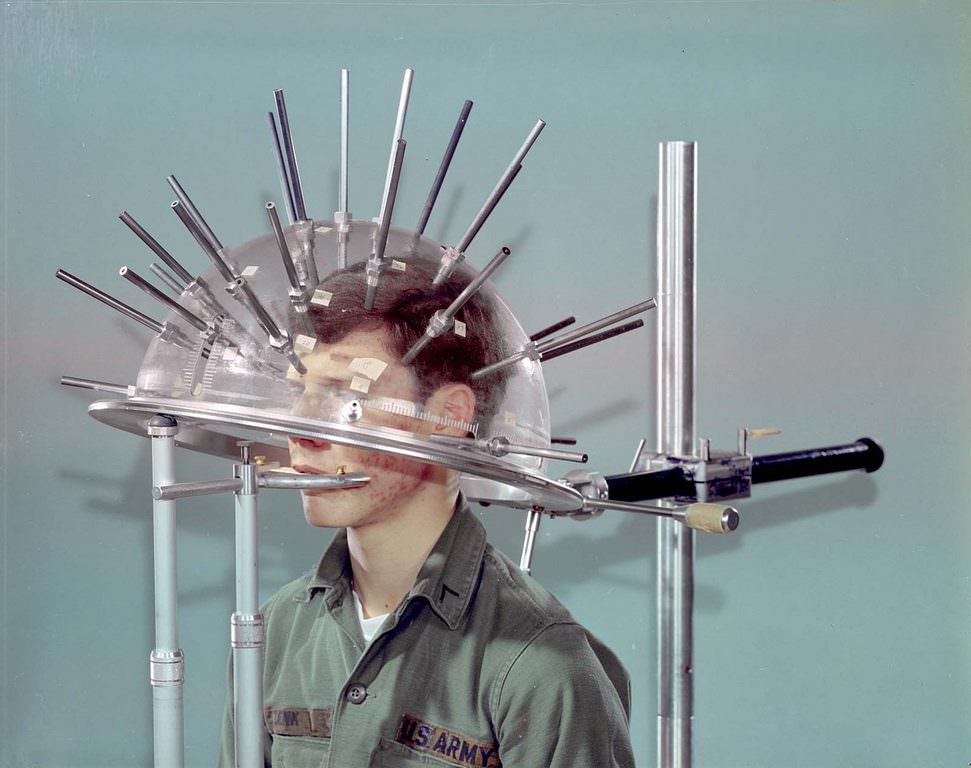
A young man sits patiently beneath a clear dome bristling with metal rods and sliding gauges, a surprisingly delicate-looking contraption for such a practical purpose. The apparatus is fixed to a sturdy stand, with rulers and adjustable arms hovering at eye level, turning the simple act of “getting fitted” into something that feels half laboratory, half workshop. In this 1973 scene, the calm posture of the subject contrasts with the busy geometry of the measuring device, emphasizing how seriously helmet fit and head shape were being studied.
What reads as quirky at first glance is really a snapshot of late-20th-century engineering culture, when safety equipment was becoming more standardized and more rigorously tested. By mapping dimensions from multiple angles, a head measuring device like this could help designers reduce pressure points, improve stability, and create sizing systems that worked for a wider range of wearers. The transparent shell also hints at a desire for precision—visibility of alignment, clear reference points, and repeatable measurements rather than guesswork.
Fans of inventions and industrial history will appreciate how this photograph captures the intersection of human bodies and mechanical measurement. It’s a reminder that helmet design isn’t just about hard materials and impact resistance; it also depends on careful ergonomics and the painstaking collection of data. For anyone searching for “head measuring device for helmets 1973,” vintage safety technology, or the evolution of protective gear, this image offers a memorable, hands-on glimpse of problem-solving in progress.