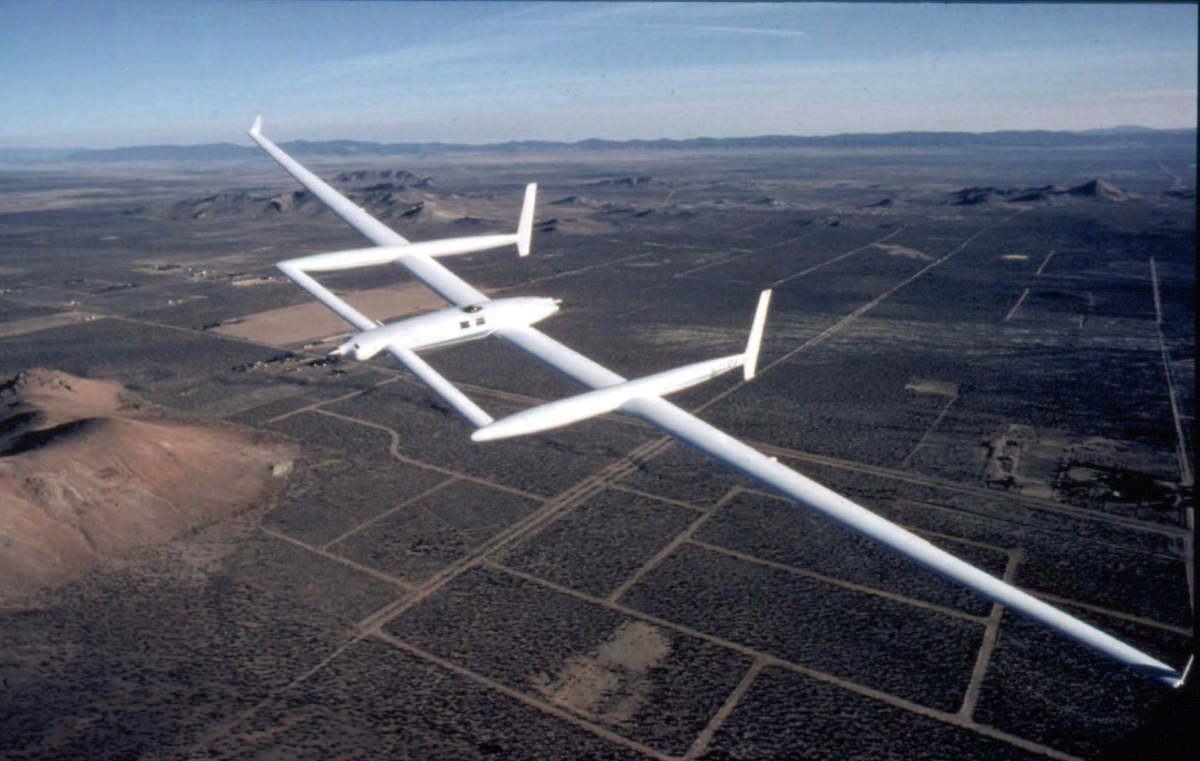
Sweeping over a quilt of desert roads and scrub, the Rutan Voyager appears almost impossibly slender—twin booms, a narrow center fuselage, and wings that stretch like a glider’s dream taken to extremes. From this vantage point the aircraft’s pale airframe stands out against the dark ground, emphasizing just how much of its success depended on efficiency rather than brute power. The scene hints at the kind of calm, high-altitude steadiness needed for a flight that demanded endurance hour after hour.
What made the Voyager’s around-the-world, nonstop, no-refueling mission such a landmark in aviation history was the way it turned design priorities upside down. Long-range flight here wasn’t about speed; it was about minimizing drag, conserving fuel, and managing weight with relentless discipline. Even without close-up detail, the unusual configuration reads like a lesson in aeronautical innovation—an experiment in making every structural choice serve the single goal of staying aloft as long as possible.
For readers drawn to aviation inventions and record-setting engineering, this historical photo works as a doorway into the era’s ambitious spirit. It evokes the tension between fragility and daring that defines pioneering aircraft: so light and stretched-out it looks delicate, yet built for one of the most punishing tests a crew and machine can face. The result is a lasting symbol of how inventive design can expand what “possible” means in flight.