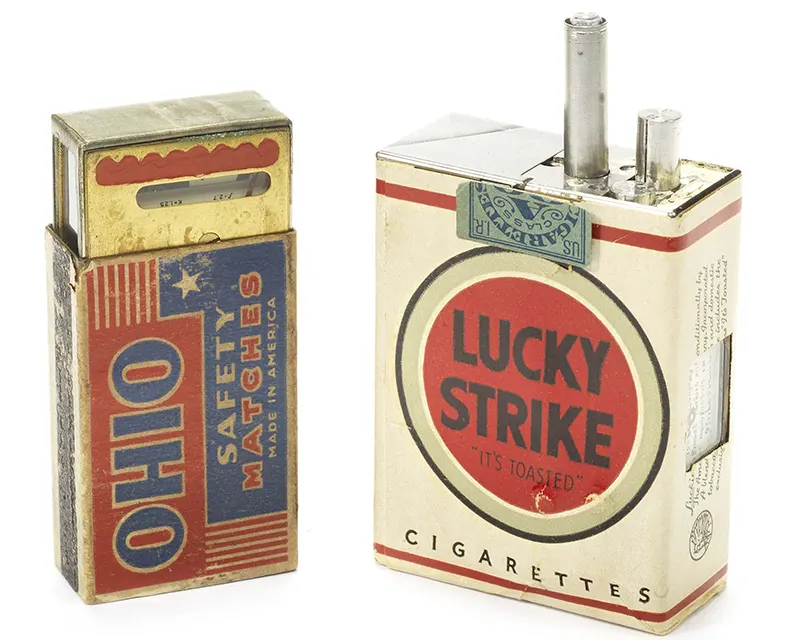
At first glance, the object reads like an ordinary pack of Lucky Strike cigarettes, complete with bold branding and the familiar “It’s toasted” slogan, yet the top edge reveals something far less mundane. A metal cylinder rises where a smoker would expect a foil seal, hinting at a concealed mechanism designed to pass casually through a glance—or a search. That tension between everyday packaging and hidden purpose is exactly what makes the Lucky Strike spy camera such a fascinating Cold War–era invention.
Alongside the pristine pack sits a worn companion marked “Ohio Safety Matches,” a contrast that underscores how easily espionage tools could be disguised among routine personal items. The clean lines of the cigarette pack conceal the practical problem military designers were trying to solve in the late 1940s: capturing images discreetly without the bulk and attention of conventional cameras. In this close view, the device’s small openings and protruding components suggest a compact internal camera system built for quick, covert use.
For collectors of spy gear, military technology, and vintage cameras, this photo offers an inviting look at the ingenuity behind concealment photography and the culture that surrounded it. The design leans on a universally recognizable consumer product, turning familiarity into camouflage and making the “camera” feel plausible in a pocket, on a desk, or in a kit. Whether you’re researching hidden cameras, Cold War surveillance tools, or unusual photographic inventions, the Lucky Strike spy camera remains a memorable example of form, function, and deception converging in a single object.