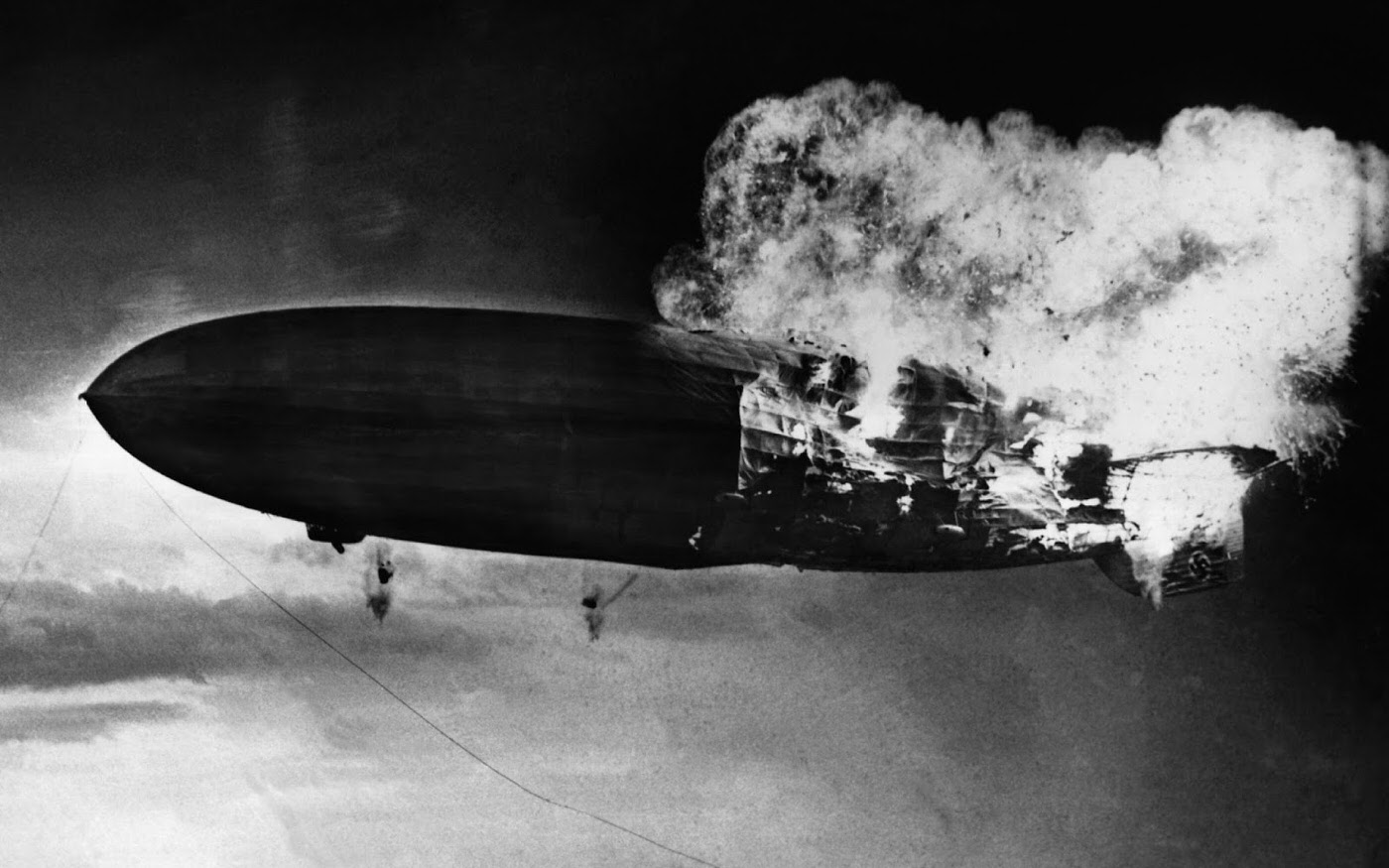
A sleek passenger zeppelin hangs against a dark sky, its long hull still intact at the front while the rear erupts into a blinding bloom of fire and smoke. The contrast is brutal: smooth engineering and orderly lines on one end, chaos and collapse on the other, with the skeletal framework beginning to show through the flames. Even without color, the photograph conveys heat, speed, and the terrible suddenness of disaster.
In many retellings, the blaze was blamed on a spark that ignited the airship’s hydrogen, turning a marvel of lighter-than-air travel into a torch within moments. The image fixes that moment in place, showing how quickly fire can race along fabric and structure when a highly flammable lifting gas is involved. It’s a stark reminder that early aviation history was shaped as much by risk and material limits as by ambition and invention.
For readers interested in the history of zeppelins, airship safety, and the rise-and-fall of hydrogen-filled craft, this photo offers a powerful entry point. It speaks to an era when engineers pushed boundaries with the tools available, and when one small ignition source could undo years of design in seconds. As a piece of historical documentation, it remains one of the most enduring visual arguments for why aviation technology—and public confidence—shifted away from hydrogen toward safer alternatives.