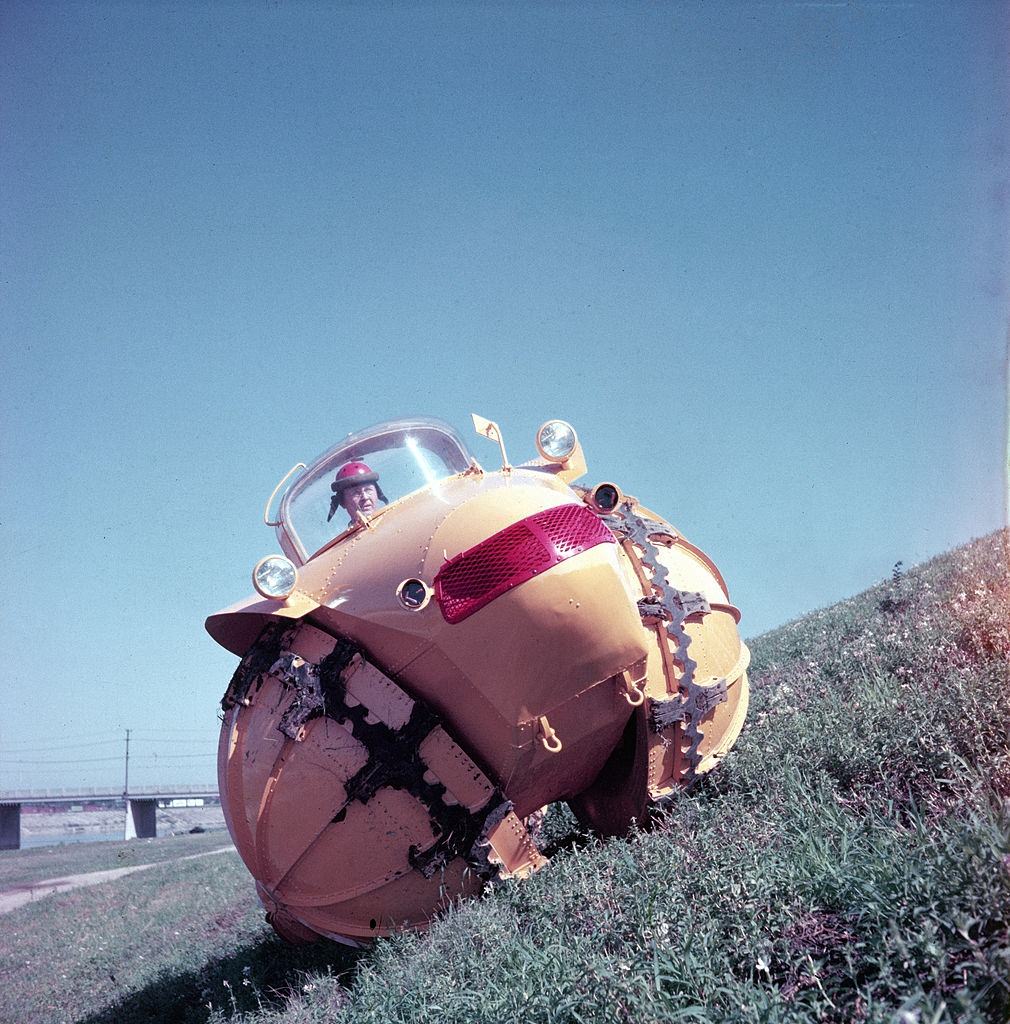
Leaning hard into a grassy embankment under a wide blue sky, the Rhino all-terrain vehicle looks less like a car and more like a compact machine built to bully terrain into submission. Its rounded, boat-like body and small cockpit hint at amphibious ambitions, while the oversized, segmented wheels—almost like rotating paddles—suggest how it could claw through mud, sand, or soft ground where ordinary tires would sink. In the distance, a bridge and open landscape emphasize that this is a test of mobility, not a showroom pose.
What stands out is the blend of practicality and futurism typical of mid-century invention culture: a simple windshield and headlamps paired with an industrial, riveted shell and a bold red grille. The driver, visible in the canopy, gives the scene scale and a sense of risk, as if the vehicle is proving itself on a steep incline before attempting the next challenge. Details like the heavy latches and reinforced seams read like engineering decisions made with water crossings in mind, where buoyancy and sealing mattered as much as traction.
For readers interested in experimental transportation, this historical photo offers a vivid snapshot of amphibious ATV design—the constant push to create one vehicle that can travel on both land and water. The Rhino embodies that problem-solving spirit: a rugged, all-terrain concept meant to bridge environments rather than specialize in just one. Whether viewed as a prototype, a demonstration model, or simply a bold idea on wheels, it captures the era’s faith that clever engineering could make almost any landscape drivable.