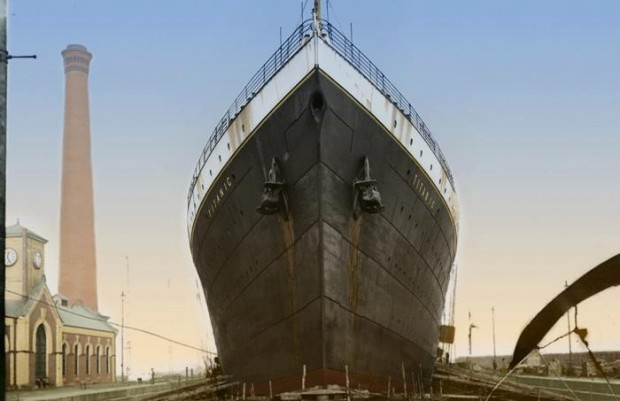
Towering above the dockside like a steel cliff, the Titanic’s bow dominates the frame, its anchor gear and riveted plates hinting at the sheer labor required to bring such a liner into being. The ship sits in a working yard rather than on an open sea, surrounded by industrial structures and tracks that underline how modern shipbuilding depended on coordinated systems—materials, machinery, and manpower moving in rhythm. Even from this low angle, the symmetry and scale sell the promise that early 20th-century engineering could master distance, weather, and time.
Behind the grandeur lies a story of invention and process: the painstaking assembly of a vast hull, the challenge of making compartments, bulkheads, and fittings work together, and the relentless push for speed and luxury at once. Details visible along the forward plating and deck lines evoke the era’s confidence in metalwork and naval architecture, when “unsinkable” became less a guarantee than a marketing mood. For readers searching Titanic construction history, this view offers a grounded reminder that legends begin in noisy yards and measured drawings long before they reach the headlines.
Memory tends to fixate on the voyage, but the rise to fame started here, where industrial ambition was staged for the public as proof of progress. Seen from the front, the liner looks less like a mere vessel and more like an emblem of a new age—one that celebrated size, technology, and the prestige of transatlantic travel. This post explores how the Titanic was built, why its innovations mattered, and how the myth of the “unsinkable” ship took shape well before the first passengers ever stepped aboard.