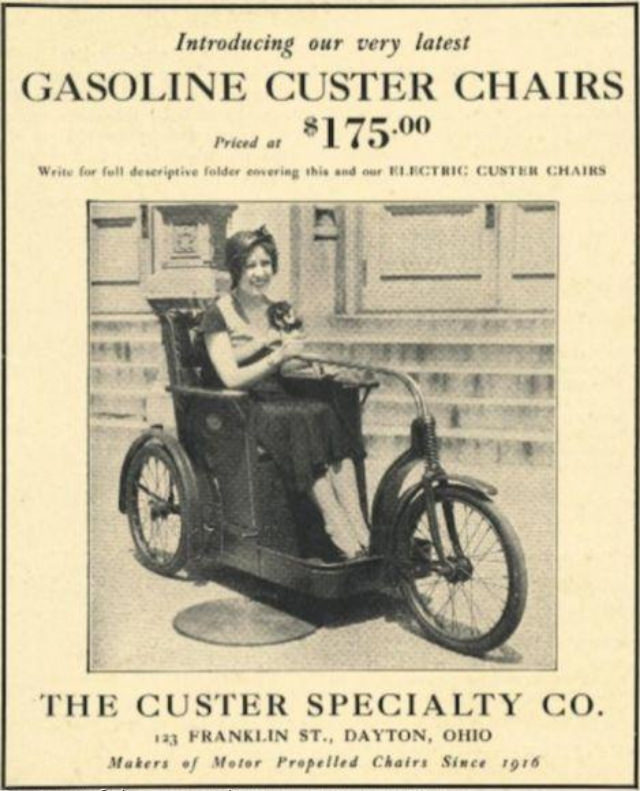
Bold type at the top announces “Gasoline Custer Chairs” priced at $175.00, setting the tone for an era when inventors and advertisers promised everyday miracles with a confident flourish. Beneath the headline sits a poised rider, smiling from a compact, motor-propelled chair with a bicycle-like front wheel and handlebars—part wheelchair, part runabout—presented not as a medical device to hide away, but as modern transportation to be shown off.
What makes the Custer Chair Car feel like a beacon of hope in the Roaring ’20s is the way it reframes mobility as independence and dignity. The design hints at practical engineering: a stable, boxy body, rear wheels for support, and a forward steering assembly that suggests controllable, street-ready movement. Even the copy invites curiosity, urging readers to “write for full descriptive folder,” a reminder of how new technology traveled through catalogs and correspondence long before the internet.
At the bottom, the advertisement credits The Custer Specialty Co. of Dayton, Ohio, calling itself “Makers of Motor Propelled Chairs Since 1916,” which ties the image to a longer story of early assistive innovation in America. For historians of transportation, disability history, and vintage inventions, this single page is rich with clues—pricing, branding, and optimistic marketing all in one frame. It’s a small window into how mechanical ingenuity and consumer culture intersected to expand freedom of movement in the early twentieth century.