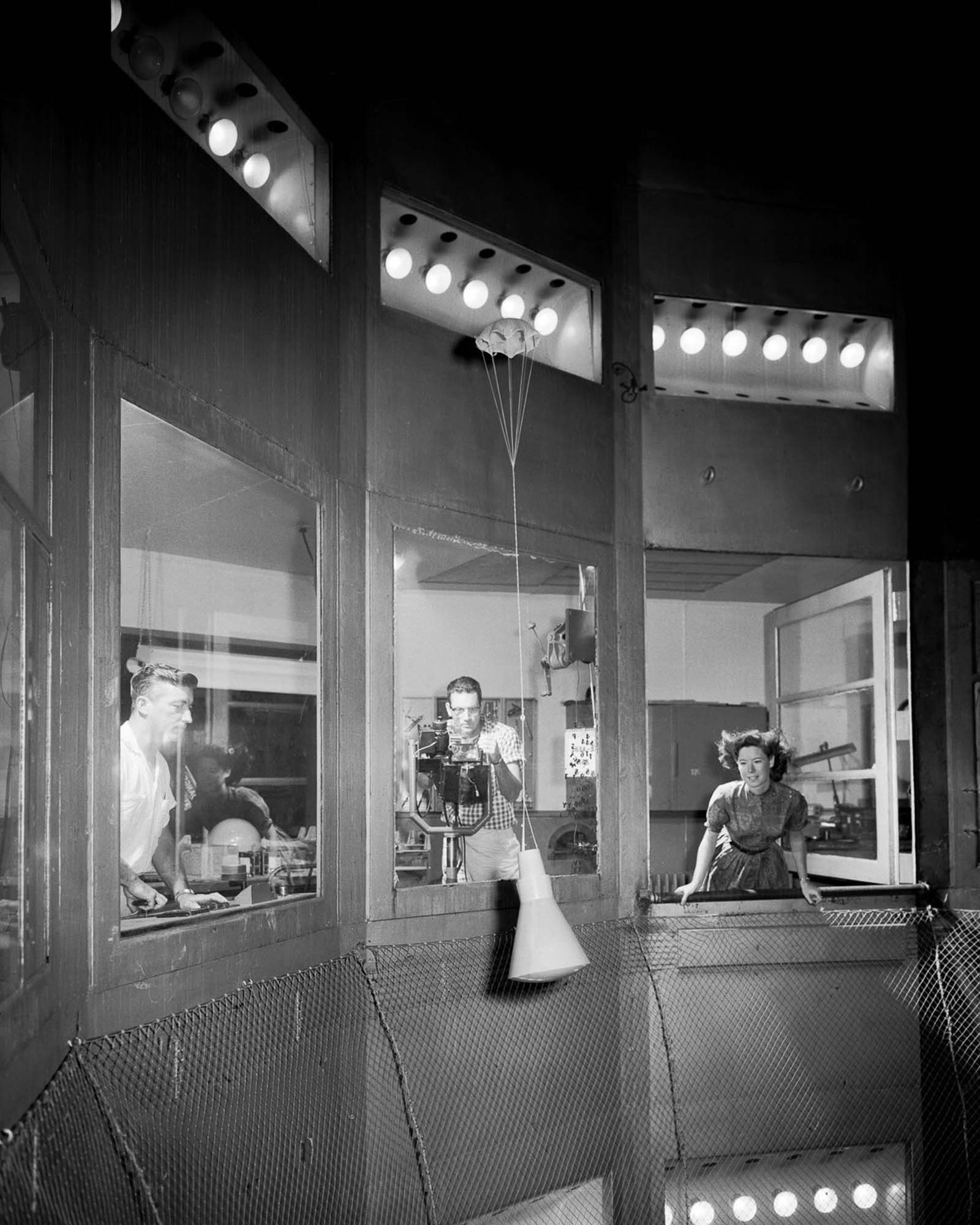
Inside the Spin Tunnel’s tall, windowed test chamber, a small Mercury Capsule model hangs on a tether beneath a cluster of lights, poised like a pendulum over the netted enclosure. The scene feels half workshop, half stage set: glass panels frame the action, and the tunnel’s curved walls and protective mesh hint at the violent, controlled airflows used to provoke spins and tumbles.
Several onlookers lean in from behind the windows—one focused on the apparatus, another working a camera—while a third watches with a mix of curiosity and caution. Their presence underscores how hands-on early spaceflight research could be, with engineers and technicians observing minute changes in motion as models pitched and yawed, chasing stable flight behavior long before a full-sized capsule ever rode a rocket.
Titled “A Mercury Capsule model in the Spin Tunnel, 1959,” this photograph speaks to the inventive, iterative mindset of the era, when wind-tunnel experimentation was essential to turning bold concepts into survivable hardware. For readers interested in Project Mercury, aerospace engineering history, or the behind-the-scenes testing that shaped human spaceflight, it offers a striking glimpse of how safety and control were engineered in the age of firsts.