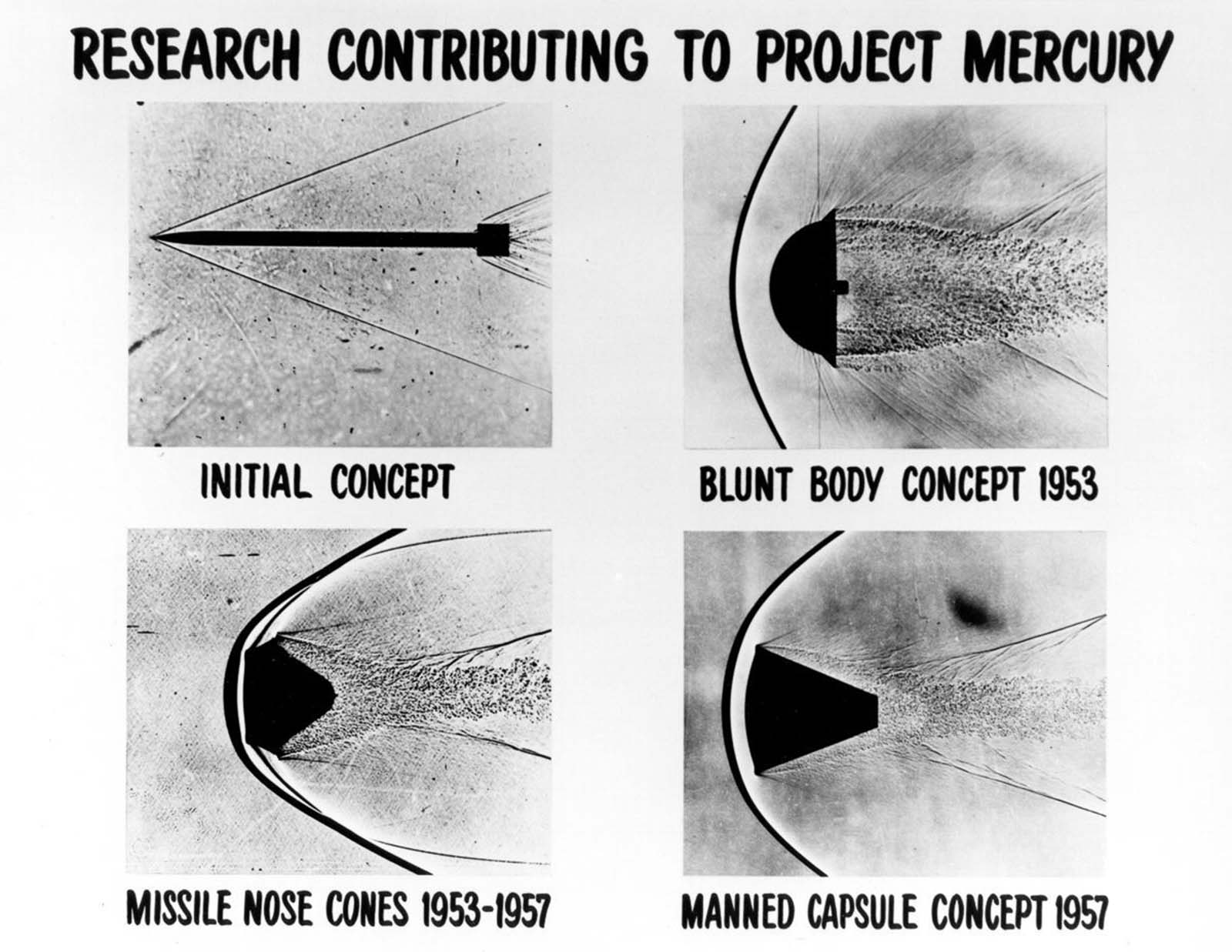
Bold lettering at the top—“Research Contributing to Project Mercury”—frames a four-panel display of shadowgraph experiments, the kind of high-speed visualization engineers used to make air itself visible. Each panel freezes the otherwise invisible disturbances that form when a vehicle pushes into the atmosphere at extreme velocity, revealing crisp shock lines and textured wakes as light bends through compressed air.
Across the sequence, the “Initial Concept” contrasts with the “Blunt Body Concept 1953,” where a rounded front drives a shockwave to stand off from the surface rather than cling to it. That separation matters: by keeping the hottest, most compressed airflow slightly away from the vehicle, a blunt-bodied design can reduce heat transfer during reentry, a counterintuitive lesson that shaped early capsule thinking as much as any rocket motor.
Lower panels labeled “Missile Nose Cones 1953–1957” and “Manned Capsule Concept 1957” underscore how aerodynamics, thermodynamics, and human spaceflight converged in the late 1950s and into 1960. For readers interested in Project Mercury history, reentry physics, and aerospace innovation, this archival montage offers a compact roadmap of how shockwave research moved from wind-tunnel imagery to practical spacecraft design.