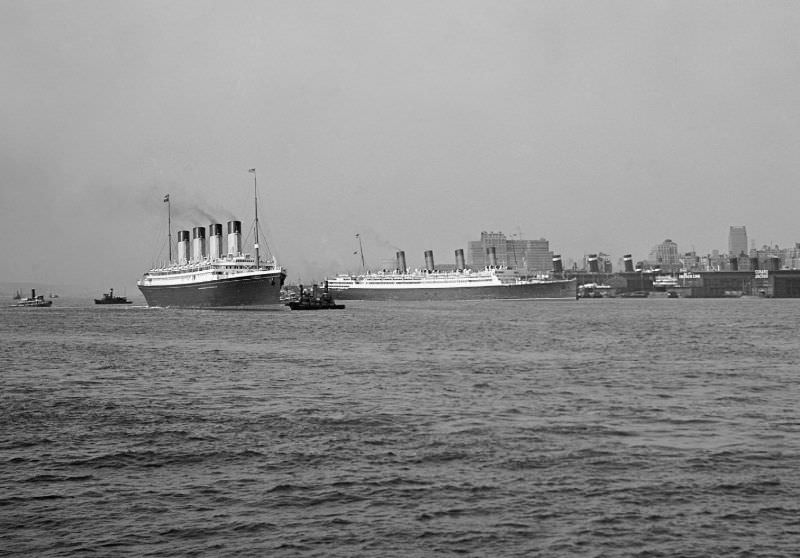
Across New York Harbor on August 8, 1934, four great Atlantic liners gather in a rare maritime tableau, their long hulls and stacked funnels cutting bold silhouettes against a hazy skyline. The nearest ship dominates the left side of the frame, riding high and purposeful, while smaller harbor craft hover nearby like attendants. Farther back, other liners sit lower on the horizon, layered in perspective and making the waterfront feel like a stage built for ocean travel.
What stands out is the contrast between sheer scale and everyday motion: tugboats and working vessels dot the water as the giants of transatlantic service wait, arrive, or prepare to depart. Smoke trails faintly from funnels, and the ships’ crisp superstructures hint at the engineering confidence of the interwar years. Even without close-up detail, the scene conveys the rhythm of the era—tight schedules, heavy mail and passenger traffic, and the constant choreography required to move these floating cities in and out of port.
For readers interested in ocean liner history, New York Harbor history, and the golden age of transatlantic travel, this photograph offers a compelling snapshot of the port at peak prestige. The title’s “four legendary Atlantic liners” invites comparison of profiles, funnel groupings, and decklines, encouraging a closer look at how different companies expressed identity through design. It’s an evocative reminder that before the jet age, voyages began here with whistles, wake lines, and the slow, confident turn of steel toward the open Atlantic.