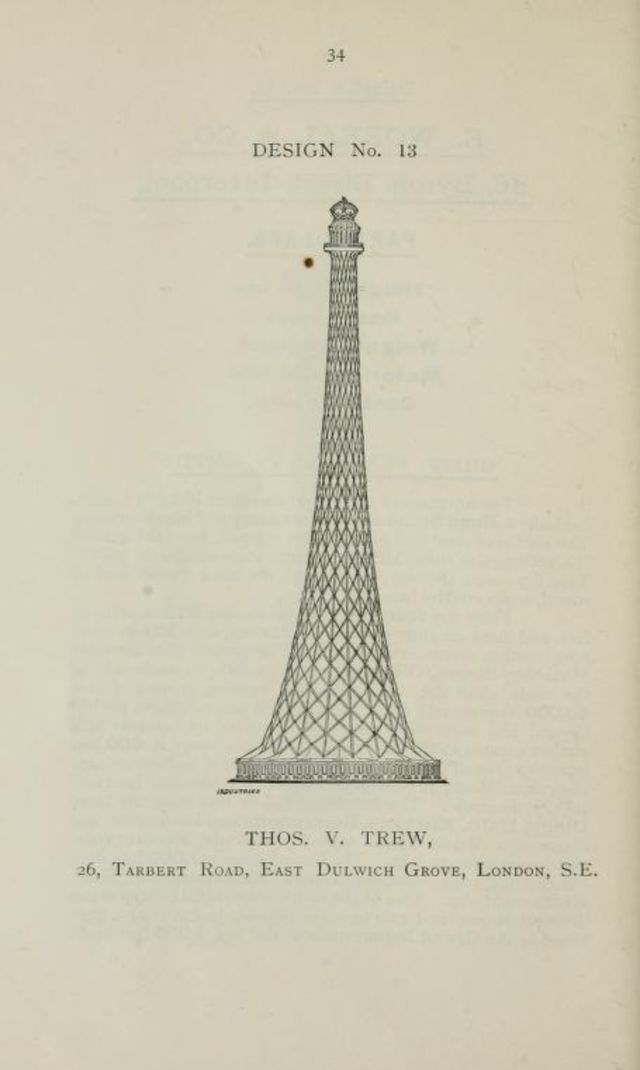
Ambition rises off the page in this competition plate labeled “DESIGN No. 13,” one of the many proposals submitted for a “Great Tower for London” during the inventive ferment of the 1890 era. The drawing presents a soaring, tapering structure built around an open lattice framework, a form that speaks to late‑Victorian confidence in engineering, ironwork, and the promise of modern spectacle. A small crown-like cap and viewing platform at the summit hint at a destination as much as a feat of construction.
The design’s proportions emphasize height above all else, with a broad base transitioning into a slender shaft that would have dominated any skyline. Cross-bracing repeats in a rhythmic pattern up the tower, suggesting both strength and a desire for visual lightness, as if the structure could climb without becoming a solid mass. Details at the base read like a ceremonial plinth—an architectural nod to monument-building—while the airy body feels closer to an exhibition structure meant to be marveled at and talked about.
Below the illustration, the printed attribution to Thos. V. Trew with a London address grounds this lofty idea in the practical world of draftsmen, submissions, and rival entries. Posts like this offer a fascinating window into competitive design culture: dozens of alternative futures sketched in ink, each vying to define what a landmark tower might be. For readers exploring London history, Victorian inventions, and unbuilt architecture, this sheet is a reminder that iconic skylines are shaped not only by what gets constructed, but by what was once imagined.