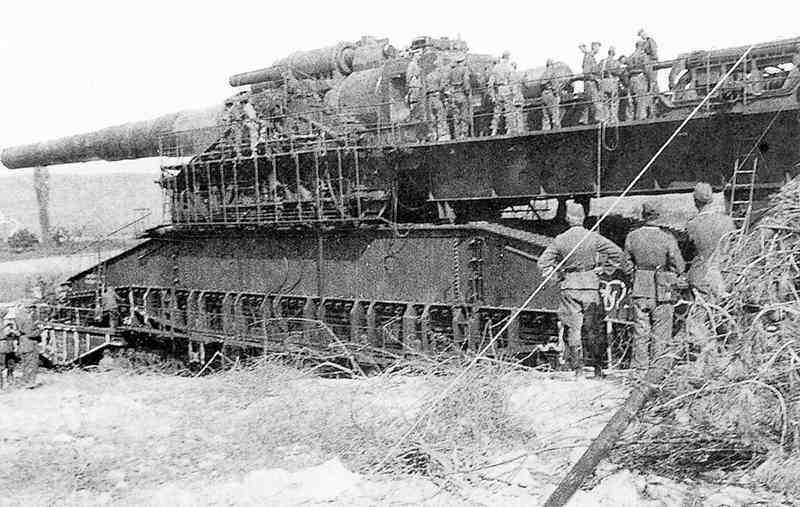
Towering over the crew clustered along its catwalks, the Gustav Gun dominates the frame like a rolling fortress, its long barrel stretching beyond the edge of the scene. Steel plates, ladders, and railings form a dense web of industrial geometry, while the tiny figures around it hint at the staggering scale that made this weapon infamous. Even in a grainy historical photo, the sheer mass of the rail-mounted design reads as both awe-inspiring and unsettling—an engineered object meant to be seen, transported, and feared.
Built as an extreme solution to a strategic problem, Nazi-era “super guns” embodied a belief that bigger machinery could break through fortified defenses. The image emphasizes that this wasn’t a simple artillery piece but a complex system: elevated platforms for operators, layered structural supports, and a chassis shaped for movement on tracks. For readers interested in World War II technology and German engineering inventions, the Gustav Gun remains a stark example of how industrial capacity was directed toward monumental, specialized weapons rather than practical battlefield flexibility.
Looking closely at the surrounding terrain and the men positioned near the base, it becomes clear that such a weapon was never just one machine; it demanded logistics, manpower, and time on a scale of its own. That tension—between technical spectacle and the brutal purpose it served—gives the photograph its enduring power as a historical artifact. As a relic of Nazi engineering, the Gustav Gun invites reflection on the era’s obsession with oversized innovations, and on what those inventions reveal about the priorities and propaganda of total war.