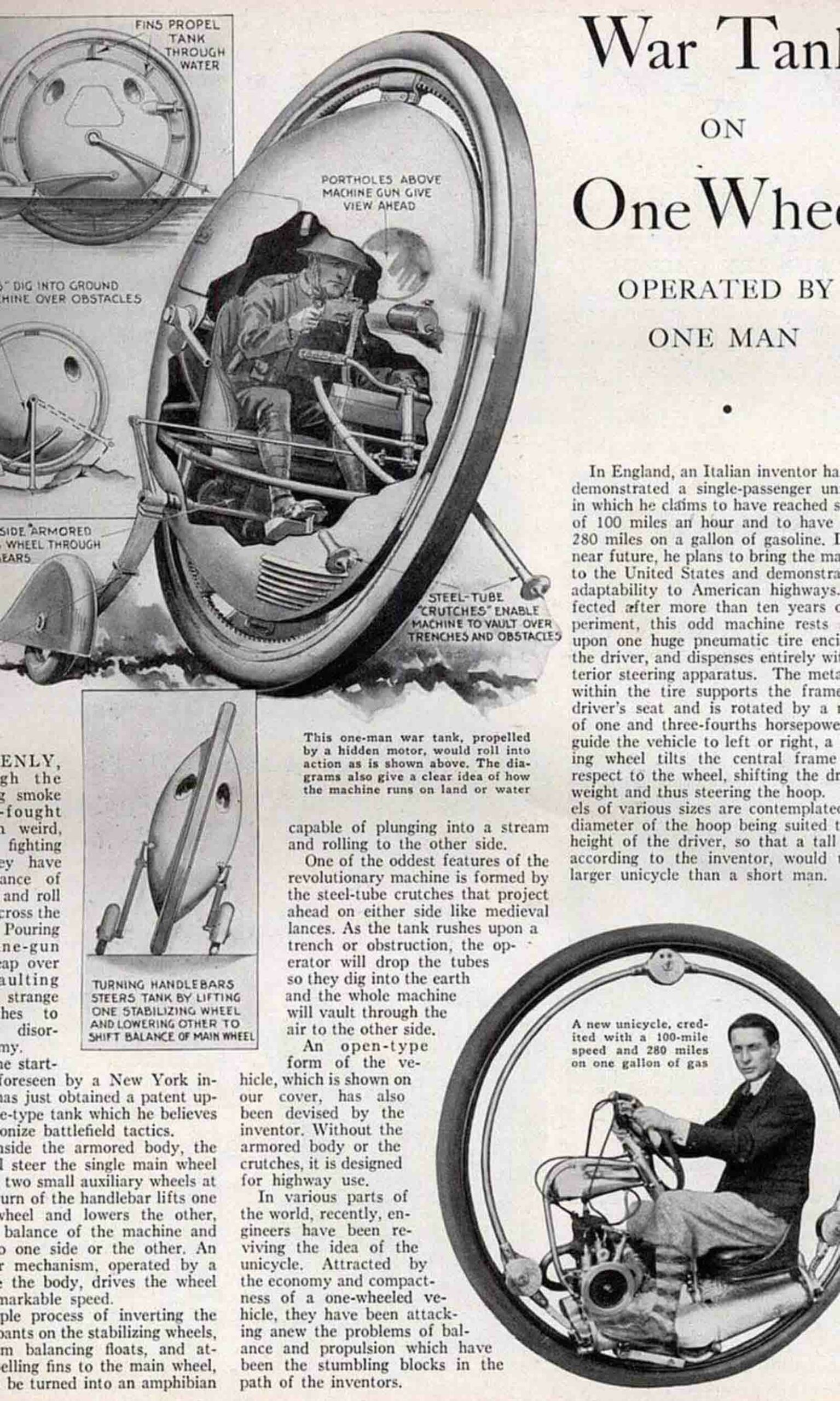
A giant ring of rubber surrounds a cramped cockpit where a lone operator grips levers and hunches forward, as if piloting a one-wheeled tank rather than a road vehicle. The illustration leans into the era’s fascination with bold mechanics—portholes for a forward view, a compact engine tucked inside the wheel, and a machine-gun-like protrusion rendered more as dramatic promise than practical hardware. Even at a glance, the monowheel’s central paradox is clear: everything—power, steering, and the rider—must live inside the spinning circle.
Margin diagrams and captions sell the concept with confident technical theater, explaining how fins might propel the machine through water and how steel-tube “crutches” could help it vault trenches and obstacles. That mix of amphibious ambition and battlefield fantasy speaks to a time when inventors and popular magazines alike blurred the line between prototype, patent drawing, and propaganda-ready vision. For readers searching monowheel facts, these details reveal what designers thought the single-wheel vehicle could solve: mobility across rough ground, compactness, and speed—without admitting how easily balance, control, and rider safety could unravel.
Another panel shows a more civilian unicycle-style setup with a seated driver framed by the wheel, hinting that the monowheel wasn’t only imagined as a weapon but also as a futuristic personal transporter. Seen together, the images summarize why bizarre vehicle inventions endure in automotive history: they compress big dreams into a striking silhouette that photographs and illustrations can’t resist. This post explores the monowheel’s design logic, the claims made for one-wheeled cars and tanks, and what these historical photos and diagrams tell us about the optimism—and the impracticalities—of early motor-age experimentation.