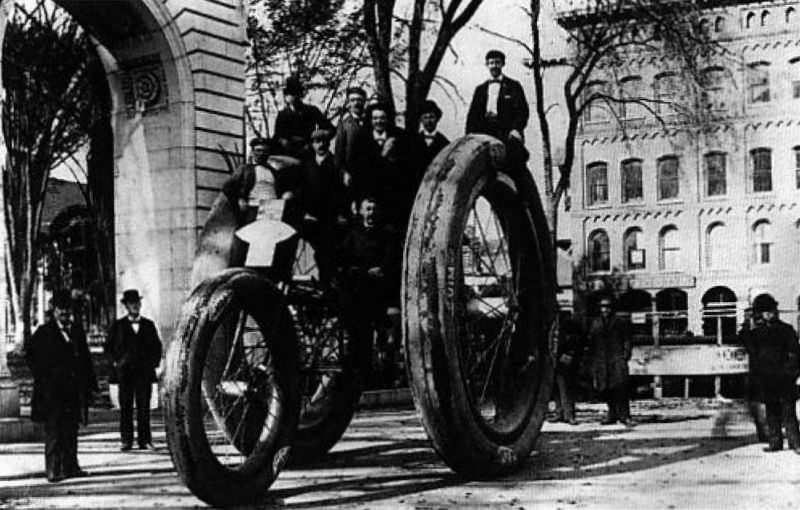
Towering wheels dominate the scene, turning an ordinary street corner into a stage for mechanical ambition. A giant tricycle-like machine sits beneath a monumental archway while well-dressed men cluster on and around its frame, their dark coats and hats emphasizing the sheer scale of the contraption. The oversized front wheel and stout rear wheels read like a bold experiment in leverage and momentum, part bicycle, part industrial apparatus.
In 1896, inventions often arrived with a whiff of spectacle, and this “giant mechanical tricycle” fits that spirit perfectly—an era when engineers and showmen sometimes overlapped. The title’s claim that eight men were required to propel it suggests less a practical vehicle than a demonstration of power, gearing, and collective effort. Even without fine technical details, the photo hints at heavy materials, a high riding position, and a drivetrain that likely demanded teamwork more than finesse.
Behind the machine, substantial masonry buildings and bare trees frame a city setting that underscores how public these experiments could be, attracting onlookers as readily as they tested new ideas. For readers interested in Victorian-era transportation history, early cycling culture, or the oddball pathways of mechanical innovation, this image offers a memorable glimpse of ingenuity scaled up to the extreme. It’s a reminder that progress wasn’t always sleek—sometimes it rolled forward on gigantic wheels, driven by many hands at once.