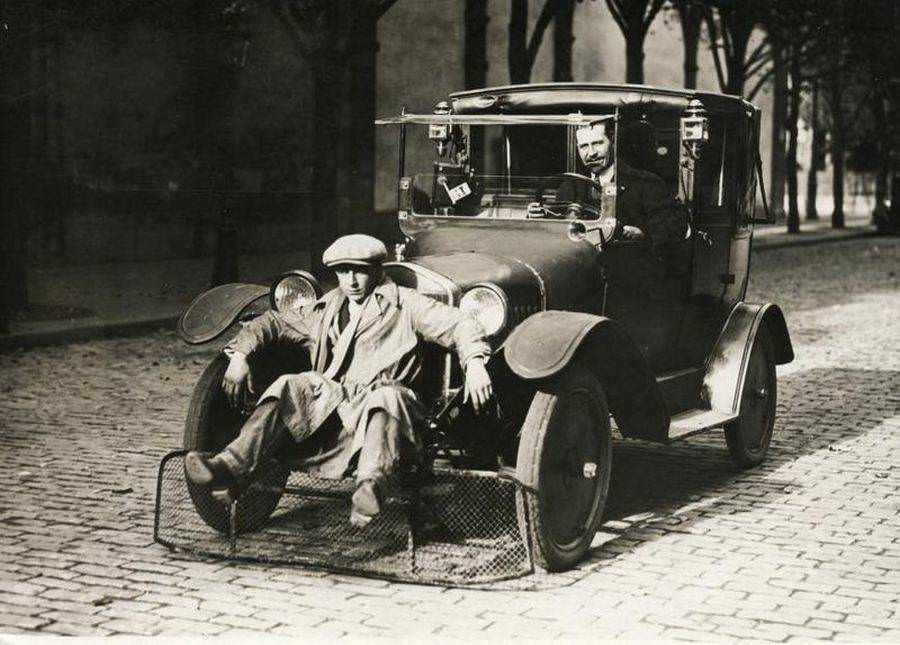
Out on a cobblestone street lined with bare trees, an early motorcar rolls forward with an unusual add-on: a wide mesh frame fixed to the front like a catcher’s mitt. A man in a cap is posed sitting on the net itself, legs extended, demonstrating how the contraption would scoop up a person rather than let them tumble under the wheels. Behind him, the driver leans toward the open window, turning the scene into a deliberate “proof” of a safety idea in an age when automobiles were still new and streets were shared spaces.
The title, “Pedestrian Safety Net,” points to the uneasy transition from horse-and-foot traffic to faster machines, when inventors tried all sorts of mechanical fixes for a suddenly dangerous problem. Instead of relying on rules, signals, or better brakes, this invention treats the front of the car as a kind of moving barrier—part guard, part stretcher—meant to soften impact and keep bodies away from the tires. The photo’s staged calm can’t hide the underlying tension: city life was changing, and public safety was struggling to keep up.
For readers interested in invention history and vintage automotive safety, this image is a reminder that today’s seatbelts, crumple zones, and crosswalk design grew out of countless experiments—some practical, some startling. The pedestrian net looks awkward, even theatrical, yet it reflects a genuine attempt to engineer compassion into a machine built for speed. Seen now, it’s a snapshot of problem-solving on the street, where ingenuity met the hard realities of early traffic.