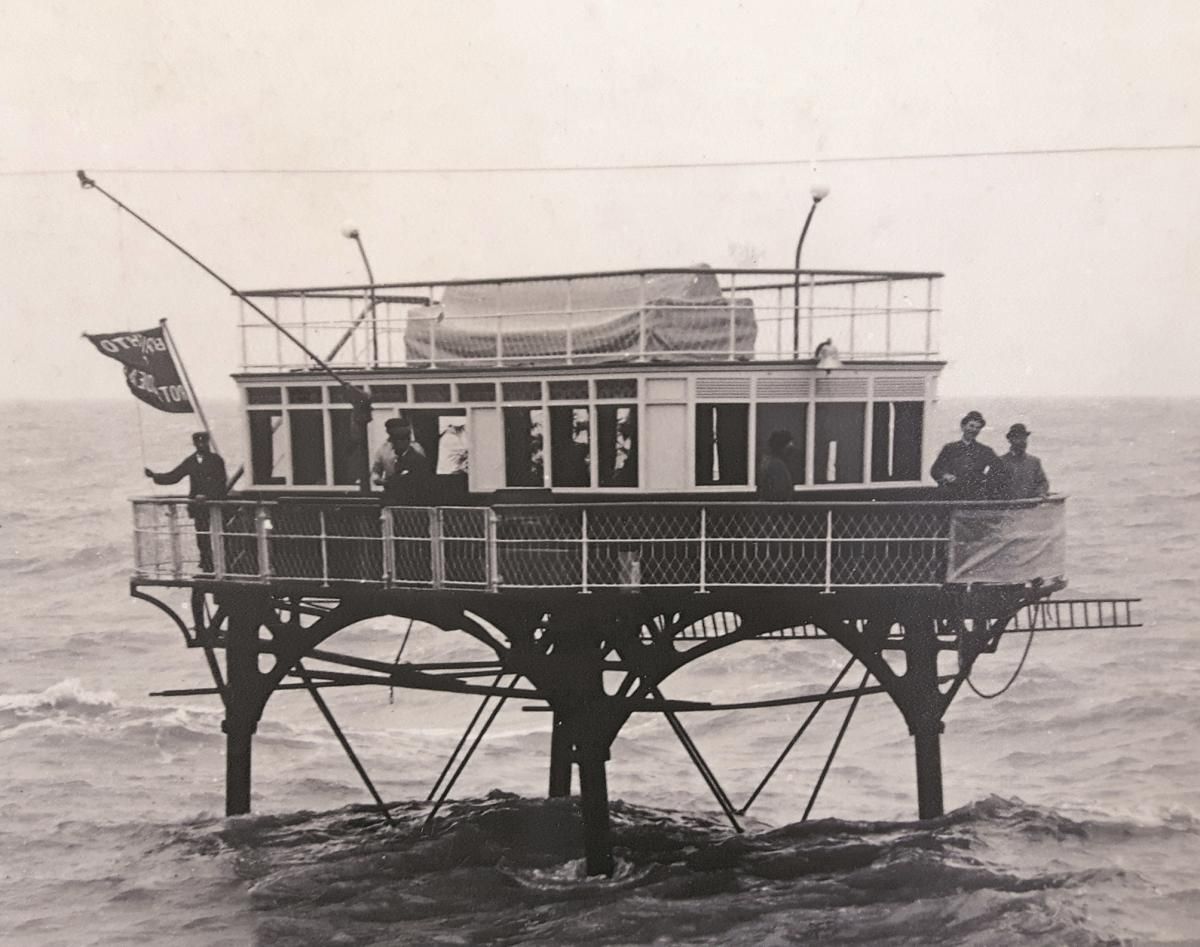
Rising above the surf on spindly iron legs, the Daddy Long-Legs Railway looks less like a train and more like a seaside contraption from a Victorian engineer’s dream. The car resembles a small tram cabin with a railed upper deck, while waves churn beneath its elevated frame, emphasizing just how daring the idea was. A handful of passengers and crew cluster along the sides, turning the ride into a public spectacle as much as a means of travel.
Brighton’s odd electric railway—introduced in 1896—embodied the era’s confidence that technology could tame inconvenient geography, even the shifting shoreline. Instead of laying conventional tracks on land, the system carried its carriage over the water, perched high enough to clear the sea’s restless movement. Details in the photo, from the braced supports to the boat-like openness of the platform, hint at the constant negotiation between machinery and the coastal environment.
For anyone fascinated by lost inventions and unusual transportation history, this image offers a vivid glimpse of experimental railways at the seaside. It’s a reminder that “progress” was often built from bold prototypes, not just polished successes, and that Brighton’s waterfront once hosted one of the strangest electric trains ever attempted. Look closely and you can almost feel the salty wind, hear the clank of metal, and imagine the uneasy thrill of traveling above the waves on a walking railway.