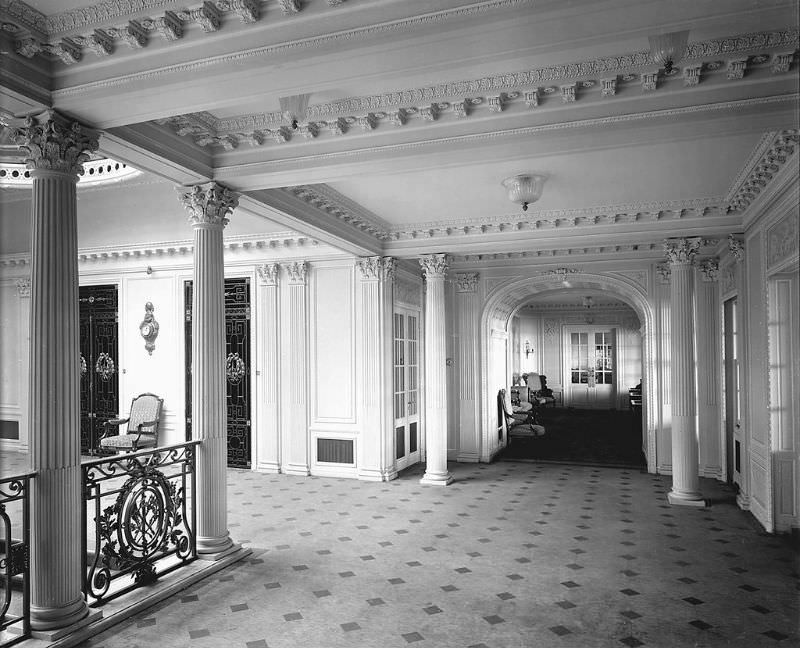
Stepping onto Aquitania’s Promenade Deck (A Deck) meant entering a world designed to impress, and the port-side Grand Entrance delivers that promise in full. Louis XVI-inspired ornament runs across the ceiling in crisp bands of molding, while fluted columns create a ceremonial rhythm along the corridor. The patterned floor and carefully spaced light fixtures underscore the liner’s ambition to feel less like a ship and more like a floating palace.
Along the left, an ornate wrought-iron balustrade hints at a nearby stairwell or opening to a lower level, adding depth and a sense of movement to an otherwise hushed space. Decorative door panels, gilded-looking accents, and the succession of arches draw the eye forward to a distant set of glass-paned doors, as if inviting passengers deeper into first-class society. Even without people in view, the arrangement of chairs and tables suggests a place where conversations began, introductions were made, and routines of luxury quietly unfolded.
Seen in April 1914, the Grand Entrance becomes more than a study in interior design—it’s a snapshot of ocean liner travel at its most confident, when craftsmanship and classical revival styles signaled modern prestige. For readers searching the history of RMS Aquitania interiors, first-class public rooms, or Edwardian-era ship décor, this photograph offers rich evidence in plasterwork, symmetry, and scale. The result is an evocative look at how early 20th-century transatlantic voyages sold not only passage, but an atmosphere of refinement.