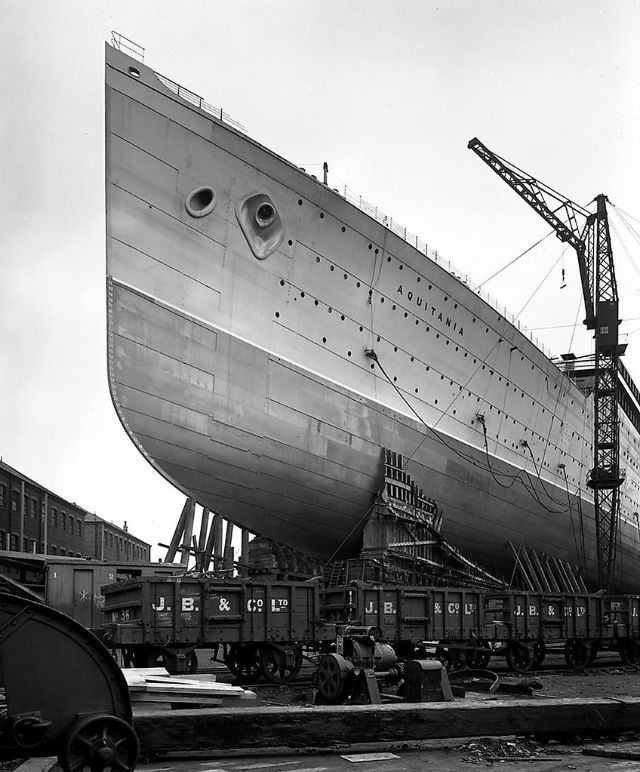
Towering above the shipyard rails and clustered wagons marked “J.B. & Co.,” the great liner Aquitania looms in near-finished silence, her bow plates riveted tight and her name already painted high along the hull. The camera angle exaggerates her sheer scale, turning the steel flank into a cliff face punctuated by portholes and seams, while a yard crane stands nearby like a measuring stick that still can’t quite convey the full height of the build.
Numbers tell the story as clearly as the metalwork: 901 feet long and 97 feet wide, with a passenger capacity laid out in stark Edwardian hierarchy—610 in 1st class, 950 in 2nd, and 1,998 in 3rd—carried on a displacement of 45,647 tons. Seen shortly before launch at John Brown & Company, circa 1913, the Aquitania represents the moment when ocean travel, industrial ambition, and engineering invention converged in a single, floating enterprise.
Look closer at the ground-level clutter—timbers, machinery, and the working yard infrastructure—and the photograph becomes more than a portrait of a ship; it becomes a record of how such giants were made. For readers searching maritime history, early 20th-century shipbuilding, or the story of the RMS Aquitania’s construction, this image offers a crisp view of pre-launch preparation and the industrial landscape that supported one of the era’s most celebrated ocean liners.