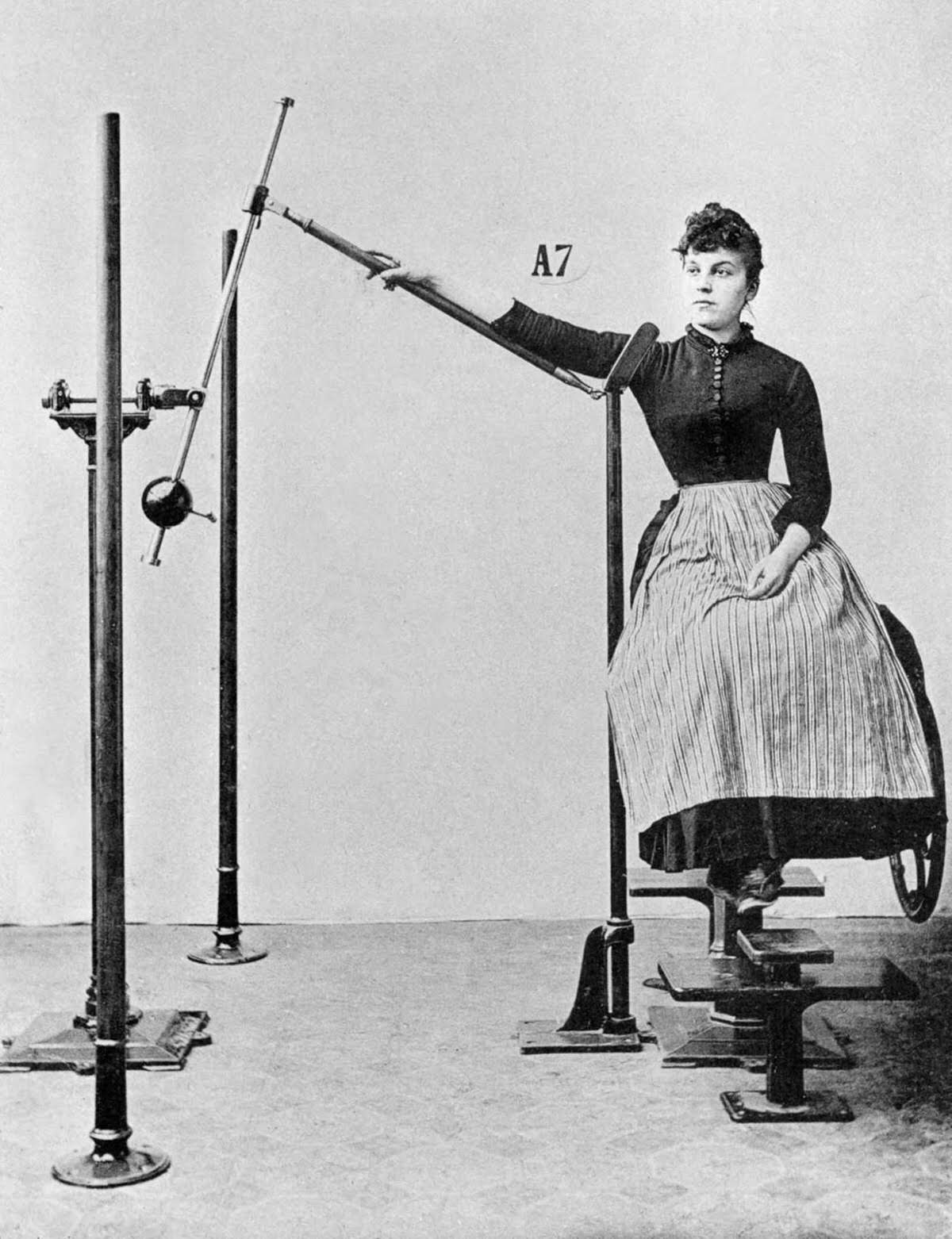
Few inventions feel as quietly ambitious as this arm-and-shoulder strengthening machine, a contraption of upright posts, rods, and pulleys designed to guide the body through controlled motion. A seated woman demonstrates the apparatus with her arm extended, the mechanism reaching toward her like an engineered “assistant” that promises steadier movement and renewed power. The label “A7” in the background suggests a cataloged series of exercises or positions, hinting at a systematic approach to physical training.
Mechanically, the setup reads like an early fusion of gym equipment and medical rehabilitation technology: a fixed seat for stability, an adjustable lever for range of motion, and a counterbalanced system meant to add resistance without sudden strain. The user’s posture—upright, composed, and carefully aligned—matches the machine’s purpose, emphasizing repeatable form over brute force. Even in a plain studio setting, the device’s spare geometry and purposeful joints convey a world increasingly confident that the body could be improved through engineering.
In the wider story of inventions, images like this sit at the crossroads of industrial design and human need, where innovation targeted everyday strength, recovery, and mobility rather than spectacle. For readers interested in the history of exercise machines, physiotherapy equipment, and early ideas about posture and muscular development, this photograph offers a striking visual record. It’s a reminder that today’s shoulder rehab tools and resistance trainers have deep roots in earlier experiments—carefully built, carefully tested, and often demonstrated in front of a simple backdrop for all to study.