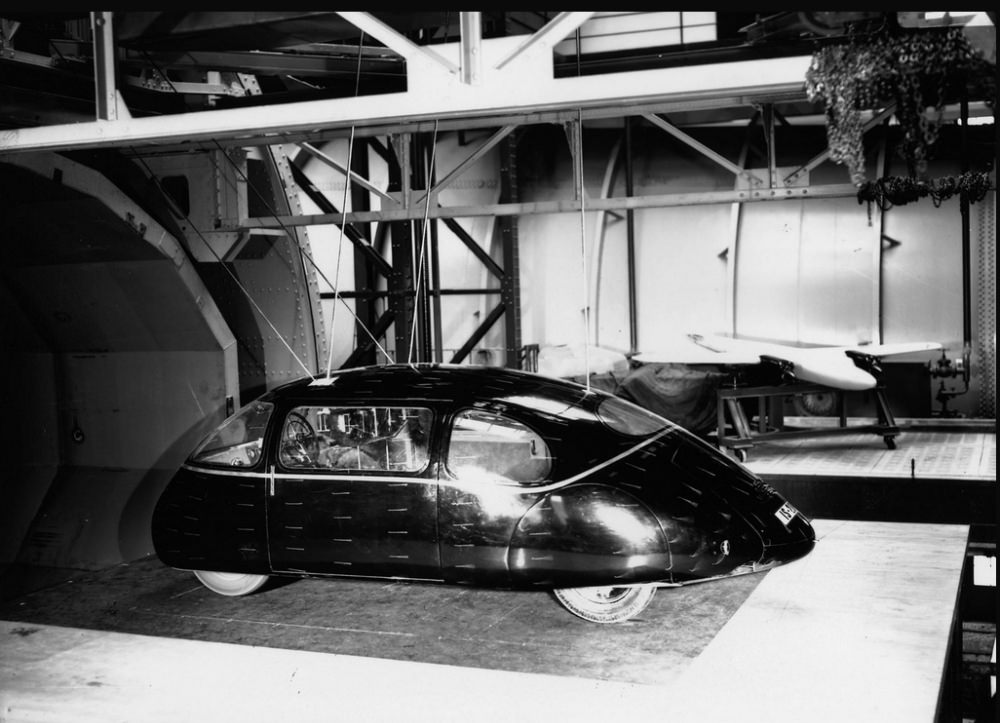
Sleek to the point of strangeness, the 1939 Schlörwagen looks more like a rolling airship than an automobile, its teardrop body swallowing the wheels and smoothing nearly every edge that could catch the wind. The cabin sits inside a glossy shell with small windows and a long, tapering tail, giving the whole machine an almost aquatic profile. Even in a static scene, the design reads as motion—an experiment in making a car slip through the air with minimal resistance.
Behind the car, the industrial setting and the large, circular test apparatus suggest a wind tunnel environment, where engineers could map airflow and measure drag rather than rely on guesswork. The faint markings across the body hint at instrumentation or measurement points, the kind of practical scarring that appears when theory meets workshop reality. It’s an evocative snapshot of interwar innovation, when aerodynamics promised a new era of efficiency and speed, and designers borrowed cues from aircraft and streamlined trains.
What makes the Schlörwagen so compelling is the gap between ambition and acceptance: an ultra-aerodynamic German prototype whose radical form never became a mainstream vehicle. The photo invites a closer look at early automotive inventions—how bold engineering can outpace public taste, manufacturing limits, and the shifting priorities of its time. For readers interested in classic prototypes, aerodynamic cars, and forgotten experiments in transportation history, this image is a reminder that the future is often tested long before it arrives.