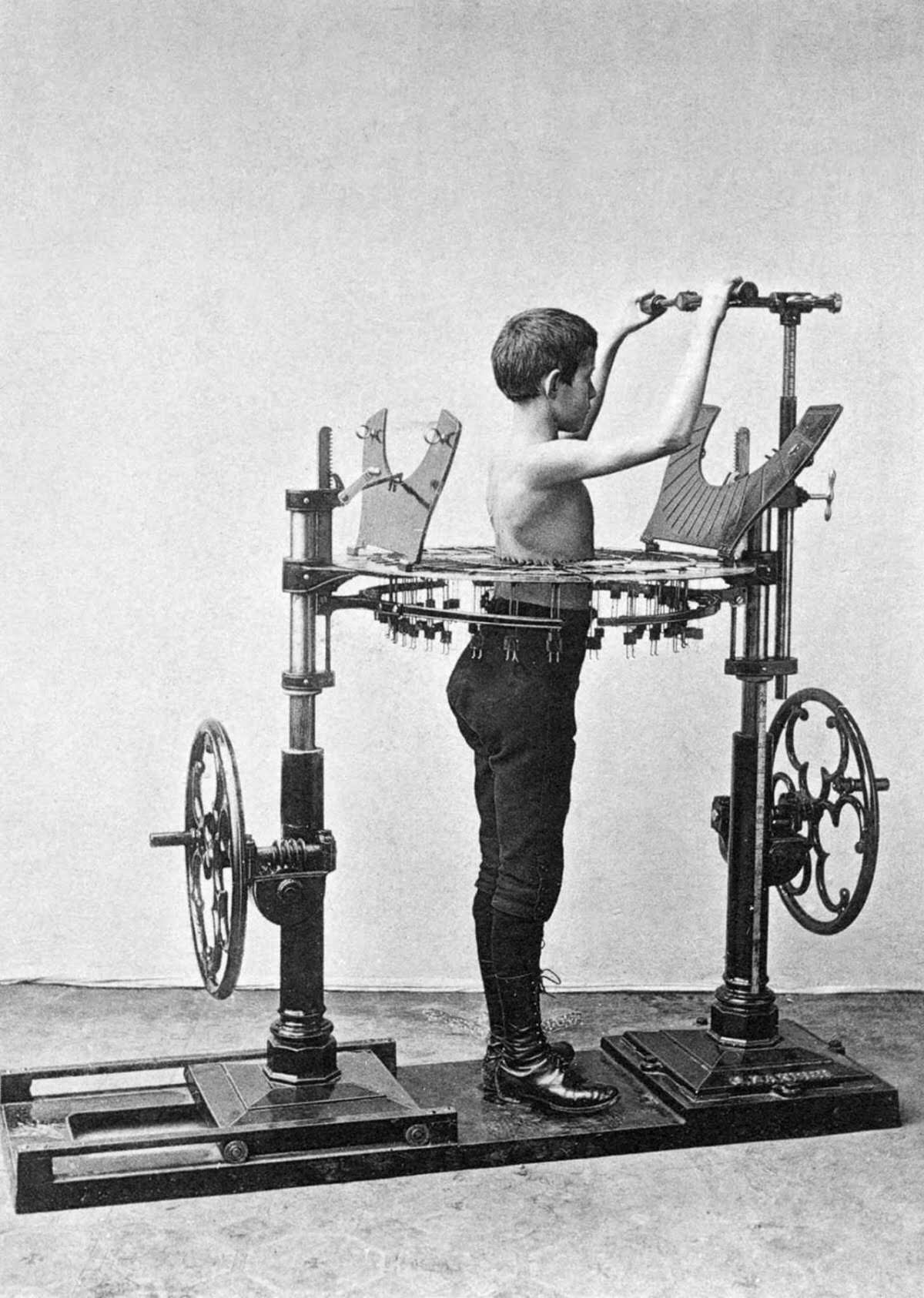
Belted at the waist by a circular frame bristling with adjustable markers, a young subject stands in profile with arms raised, as if submitting to a careful, mechanical inspection. The apparatus—part ring, part measuring cage—looks engineered to map the body’s outline at a specific level, turning soft curves into numbers and positions that could be compared later. Large handwheels and vertical posts suggest the whole system could be tightened, aligned, and calibrated with the seriousness of workshop machinery.
Devices like this cross-sectional measuring instrument belong to an era when inventors and technicians chased objective ways to track physical change, whether for clothing fit, physical training, medical observation, or the growing science of anthropometry. Instead of relying on a tailor’s tape alone, the machine promises repeatable measurements by fixing the body’s posture and capturing a “slice” of the torso in a consistent plane. Seen today, the combination of human vulnerability and industrial precision is striking: the body becomes a specimen, and the workshop becomes a laboratory.
For readers interested in the history of inventions, this photograph offers a window into early body-measurement technology—an ancestor to modern scanners, fitness assessments, and biometric tools. The spare studio backdrop throws all attention onto the contraption’s ornate metalwork and the disciplined stance required to use it, underscoring how much effort once went into recording simple physical dimensions. It’s a reminder that the desire to quantify the human form is not new; only the instruments have changed.