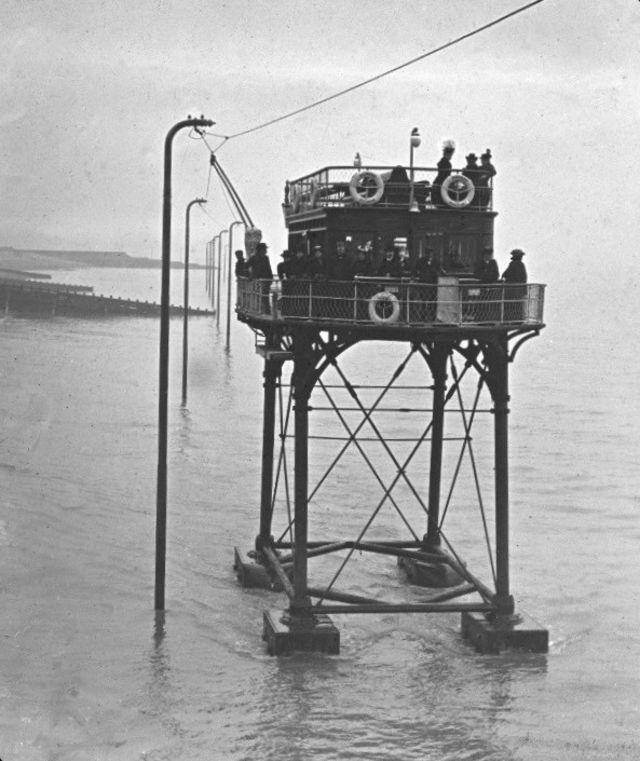
Rising above the tide on spidery iron legs, the strange carriage of Brighton’s “Daddy Long-Legs” railway looks more like an offshore platform than a train. Passengers crowd the upper deck behind railings, while lifebuoys hang at the sides—a practical touch for a vehicle that travels with seawater swirling beneath it. The overhead power line and tall poles hint at the bold promise of late‑Victorian electric transport, brought right to the edge of the English Channel.
Unlike ordinary seaside railways that hug the promenade, this invention ran out across the shallows on a track laid on the seabed, keeping the car body safely above waves and spray. The design turns the beach into a stage: the distant coastline fades into mist, and the slim supports march away along the route, emphasizing just how exposed the journey must have felt in rough weather. It’s an unforgettable example of the era’s confidence that engineering could tame nature with steel, wiring, and clever geometry.
For readers interested in unusual Victorian inventions, coastal history, or early electric trains, the Daddy Long-Legs Railway of Brighton is a perfect case study in ambition and improvisation. The photo captures the spectacle of a seaside electric railway that was part transport, part attraction—an experiment that still sparks curiosity because it looks so improbable and yet so methodical. If you love forgotten transport oddities and maritime technology, this odd little “walking” train is the kind of story that keeps you scrolling.