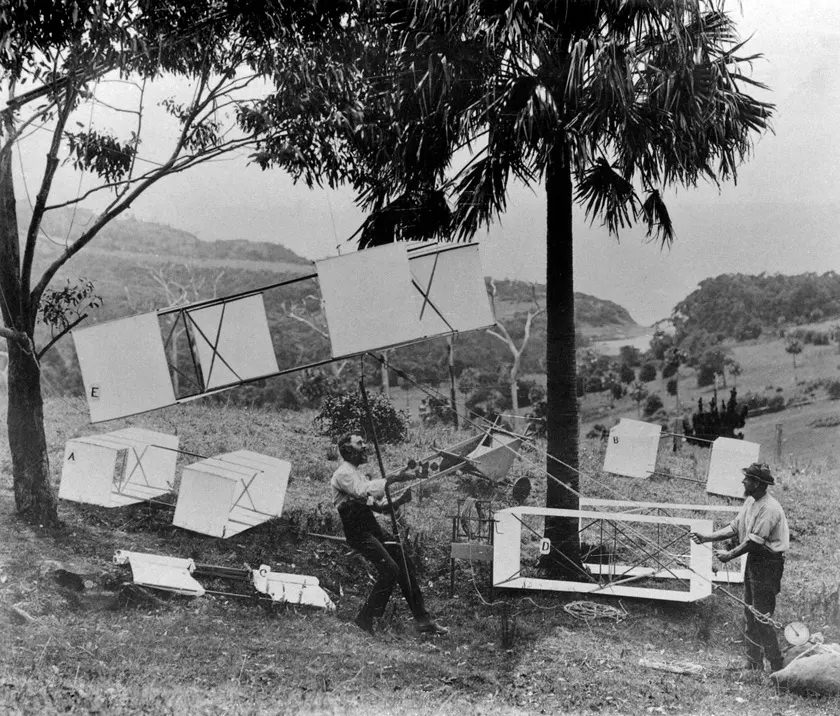
On a grassy slope at Stanwell Park, a cluster of box-like kites stretches across the frame, their fabric panels braced by struts and crossed rigging. Lawrence Hargrave sits low within the assembly while another man stands nearby, gripping lines that run taut through the air. Behind them, trees and a sweeping coastal landscape set a dramatic stage for an experiment that feels both improvised and meticulously engineered.
Hargrave’s man-lifting kites are arranged like a train of aeronautical modules, each cell designed to catch the wind and stabilize the pull. Lettered markings on the kite frames and the visible network of cords hint at a methodical approach—testing, recording, refining—rather than a mere curiosity. The scene conveys the physical reality of invention: heavy spars, tight knots, and the careful teamwork required to translate an idea into lift.
Viewed today, this 1894 photograph reads as an early chapter in the history of flight, when controlled ascent was pursued with kites before powered aircraft reshaped the skies. It’s an evocative piece for anyone interested in Australian innovation, pioneering aerodynamics, and the practical craft of nineteenth-century experimentation. The combination of human scale, rugged terrain, and bold engineering makes this image a standout for posts exploring inventions that helped point the way toward aviation.