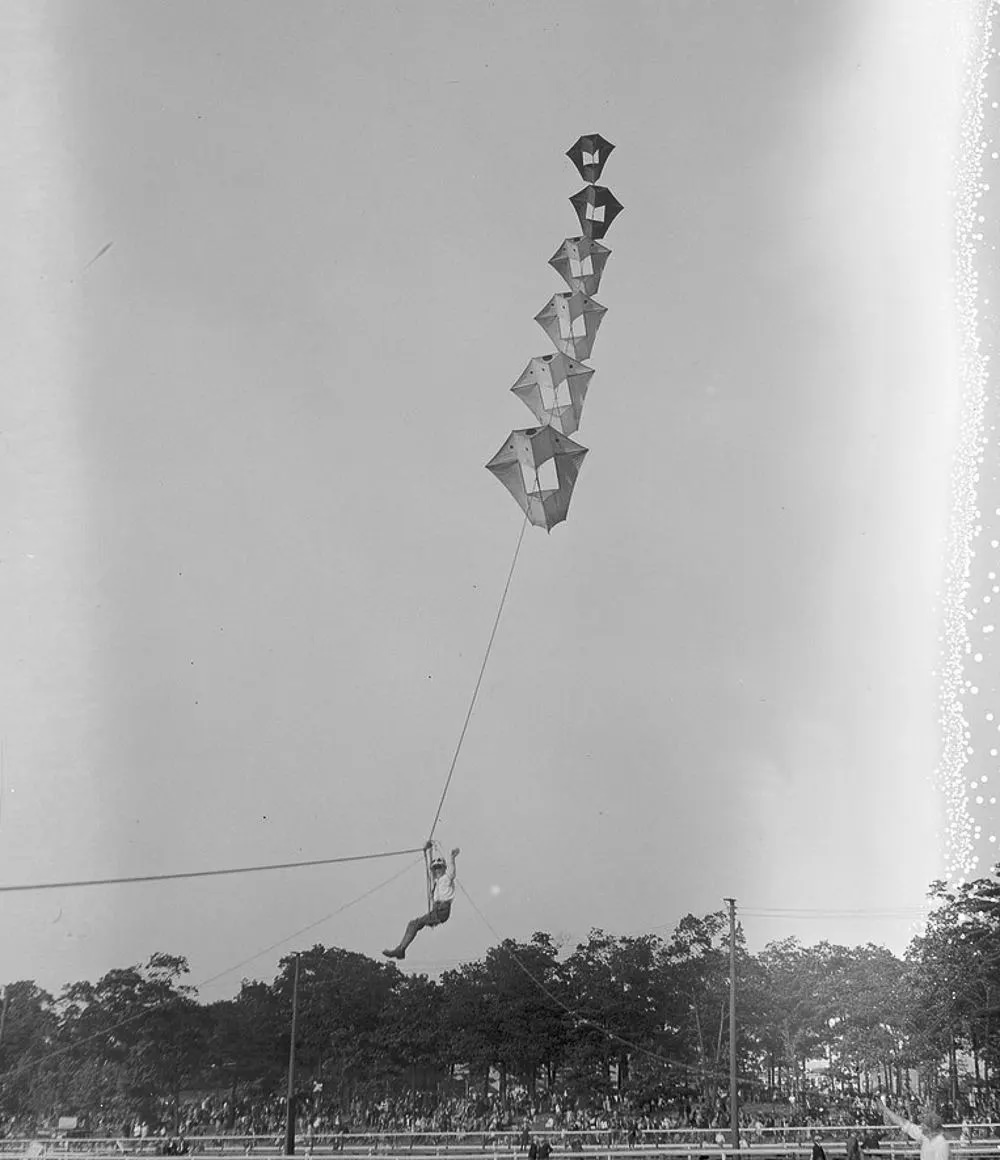
High above a crowded field, a long train of boxy kites strains into the wind while a single rider hangs beneath the rigging, suspended like a human pendulum. The ground below reads as a blur of spectators, trees, and utility poles—everyday landmarks that suddenly look small from this improvised skyway. It’s a striking reminder that getting airborne didn’t always require an engine; sometimes it took only canvas, spars, and nerve.
Man-lifting kites were more than fairground spectacle, and the logic behind them was surprisingly practical: stack multiple lifting surfaces, stabilize them with lines, and gain height fast for a clearer view. Before aircraft became reliable and widely available, kite systems offered a portable form of aerial reconnaissance—an elevated lookout point that could be launched from open ground whenever conditions cooperated. The photo’s segmented kite train hints at careful engineering, with repeated cells designed to share load and keep the whole assembly steady.
Seen today, the scene reads like a crossroads between invention and adventure, where experimentation with wind power edged toward modern aviation. For readers interested in early military technology, surveillance history, or the inventive detours that shaped flight, this image anchors the story in something tangible: a person literally lifted by the atmosphere. The post explores how these aerial reconnaissance kites worked, why they mattered, and how quickly they were eclipsed once airplanes and other technologies took over the skies.