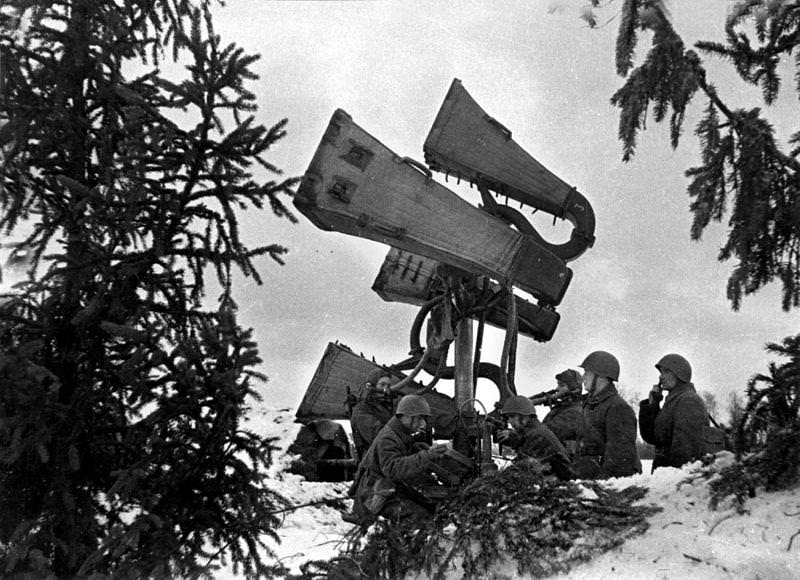
Jagged, boxy acoustic horns rise from a snowy clearing, their wide mouths angled toward the sky as a small group of helmeted operators huddle around the controls. Conifer branches frame the scene, emphasizing how these listening stations were often placed where open sightlines and quiet air could help carry the faint signatures of an approaching aircraft. The sheer scale of the apparatus makes the idea instantly clear: before radar became the standard, warning systems sometimes relied on the oldest sensor of all—sound.
Long before electronic screens and blips, air-defense crews experimented with “sound locators” that gathered and concentrated engine noise, then guided observers toward the direction of travel. By adjusting the horns and carefully comparing what each side picked up, teams tried to estimate where a plane might be and how soon it would arrive, turning mechanical ingenuity into precious minutes of preparation. The photo’s wintry setting and bundled figures underline the practical challenge: listening for distant propellers in real weather, with real urgency, and no guarantee that the sky would cooperate.
Seen today, these giant acoustic horns read like a transitional technology—half industrial sculpture, half battlefield instrument—linking early aviation threats to the coming age of radar. They also make for a compelling chapter in the history of inventions, when engineers chased detection not with microwaves and circuitry but with wood, metal, geometry, and trained ears. If you’re drawn to forgotten military technology and the evolution of aircraft detection, this image offers an unforgettable glimpse of the world “before the radars.”