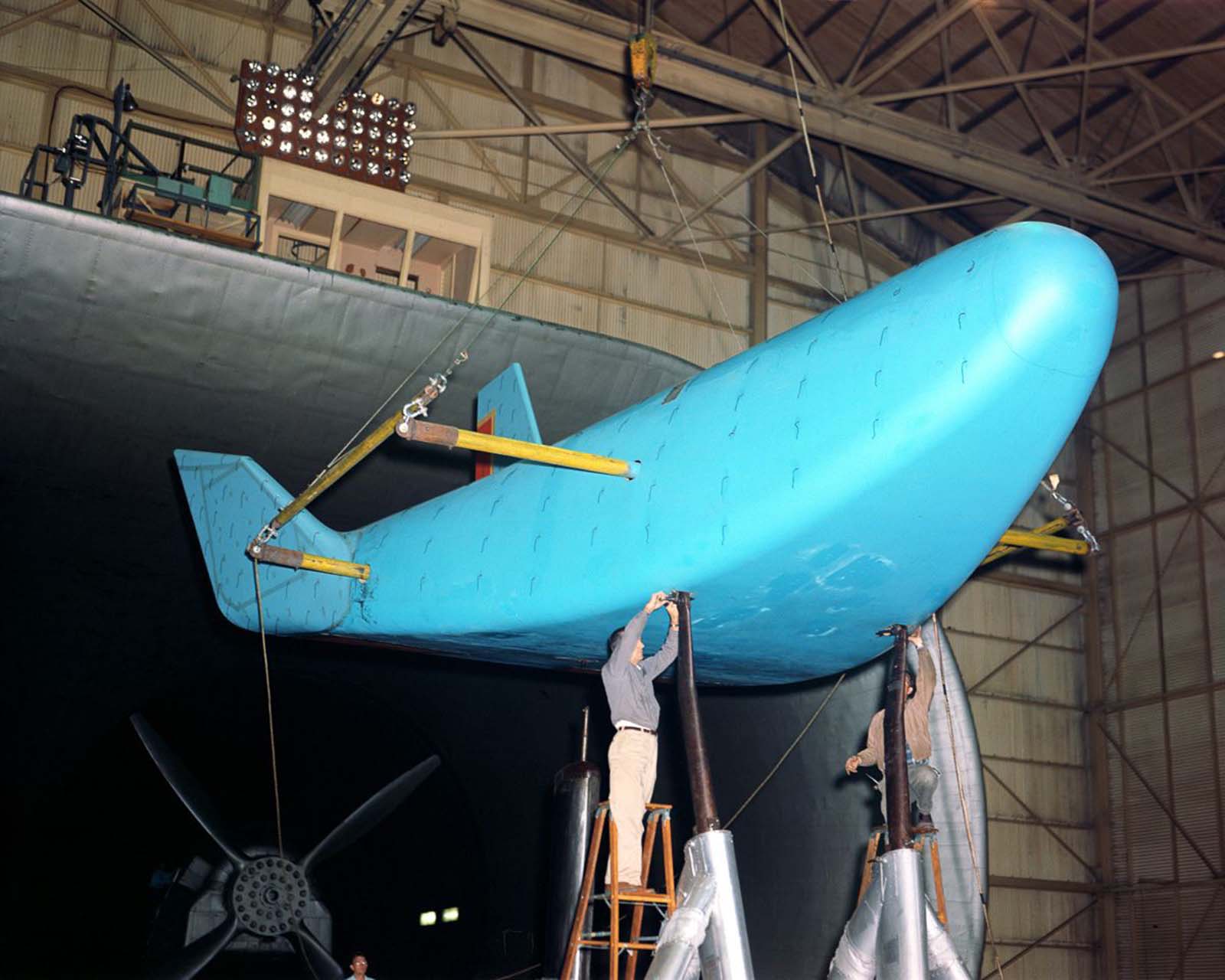
Suspended high inside Langley’s cavernous 30 x 60 Full Scale Tunnel, a full-scale HL-10 lifting body model hangs like a sleek, sky-blue question mark against the industrial geometry of beams, cables, and catwalks. The blunt nose and smooth, wingless form draw the eye, while the rigging and support struts reveal the practical choreography required to place an experimental aircraft shape precisely in the airstream. Even the tunnel’s massive fan assembly in the background hints at the controlled force that would soon roar through this space.
Engineers on ladders work beneath the model, tightening fittings and aligning hardware with the careful, hands-on precision that defined mid-century aeronautics. The scene feels less like a dramatic launch and more like the quiet moment before a decisive measurement—when airflow, pressure, and stability would be translated into numbers and plots. Every cable angle and attachment point speaks to the discipline of wind tunnel testing, where small adjustments can change the story an aircraft shape tells.
Titled for 1964, this photograph places the HL-10 squarely within the era’s drive to understand lifting bodies—designs that could generate lift primarily from their fuselage rather than traditional wings. In that context, the image becomes more than a technical setup: it’s a snapshot of aerospace innovation in progress, bridging laboratory experimentation and the broader quest for controlled atmospheric reentry and efficient flight. For readers searching terms like “HL-10 lifting body,” “Langley Full Scale Tunnel,” or “wind tunnel testing,” this is a vivid, behind-the-scenes window into how ambitious ideas were proven in air before they were trusted in the sky.